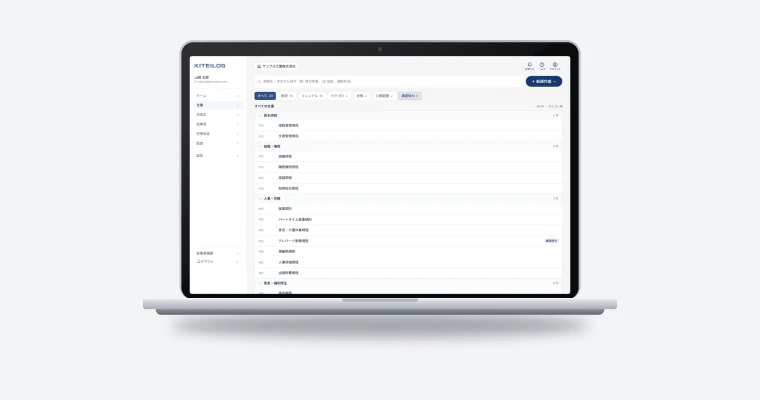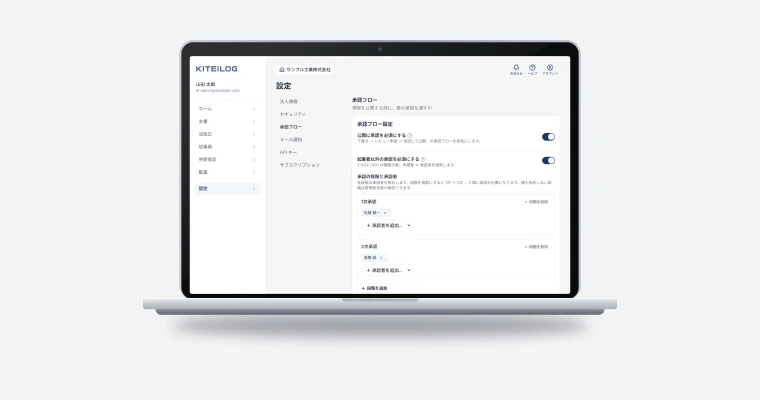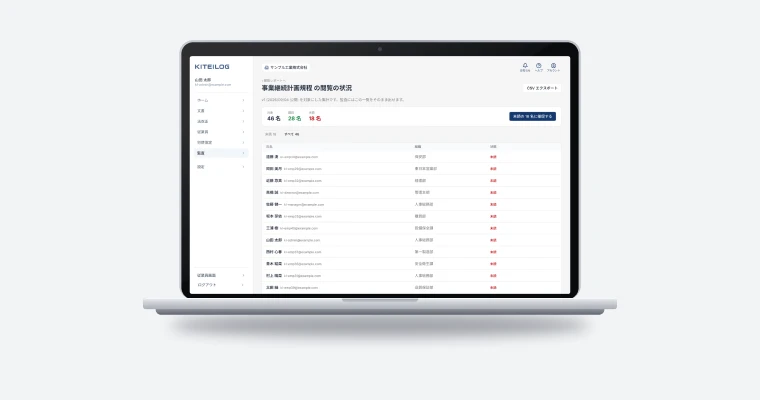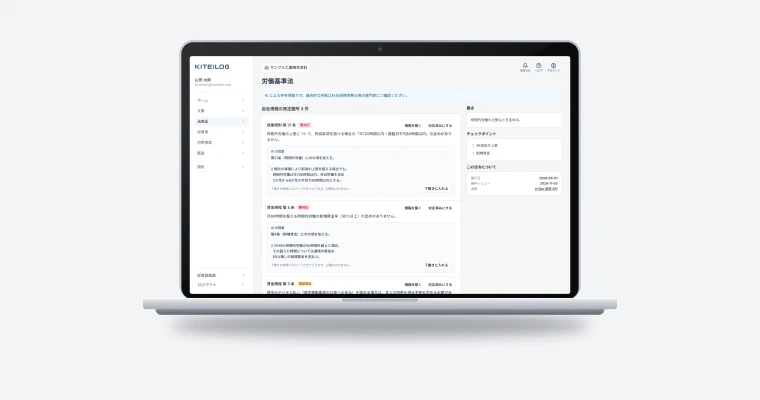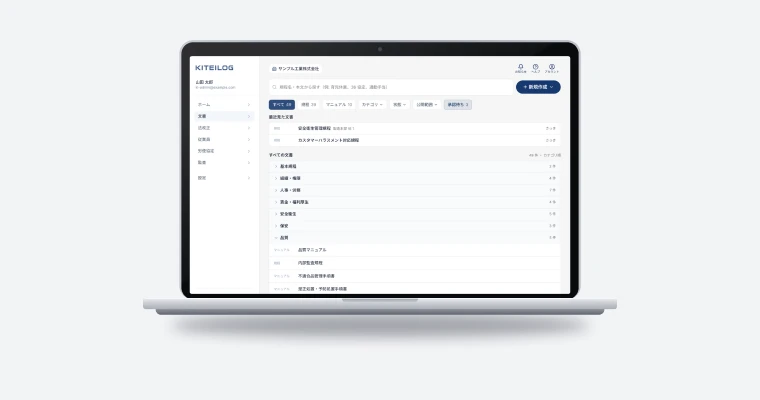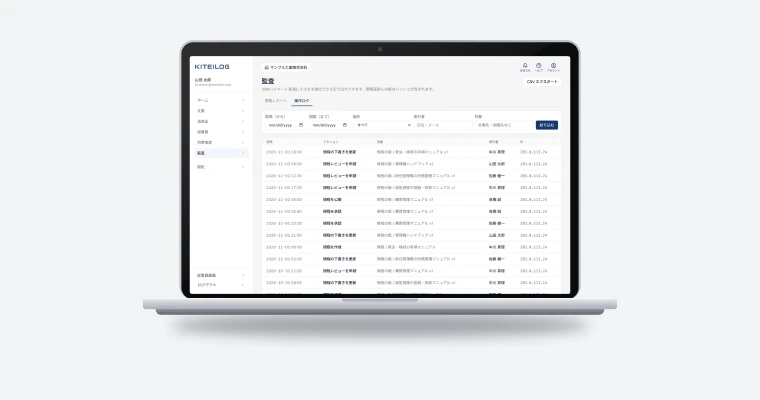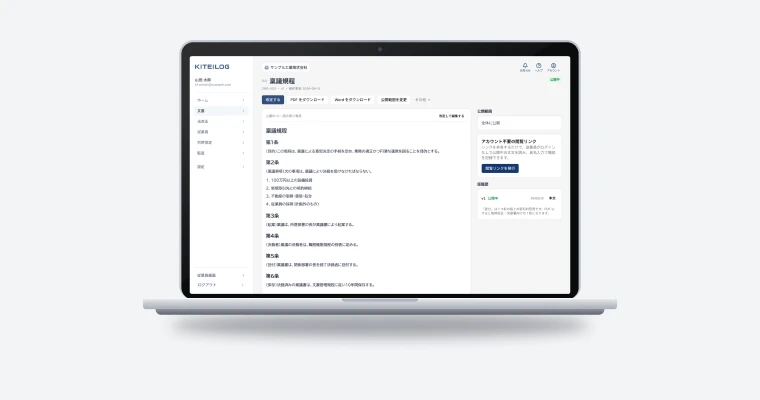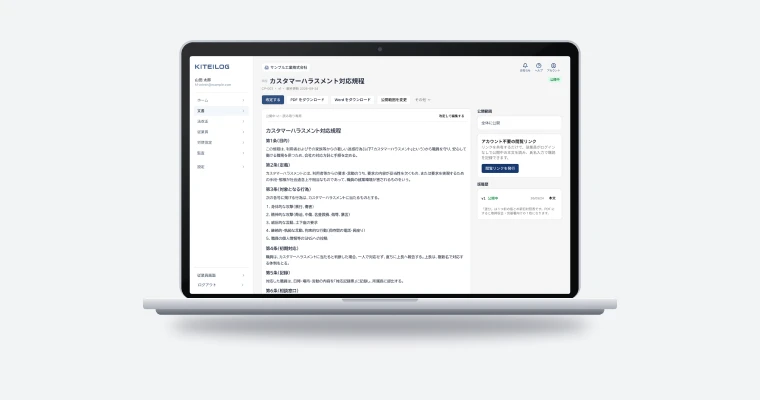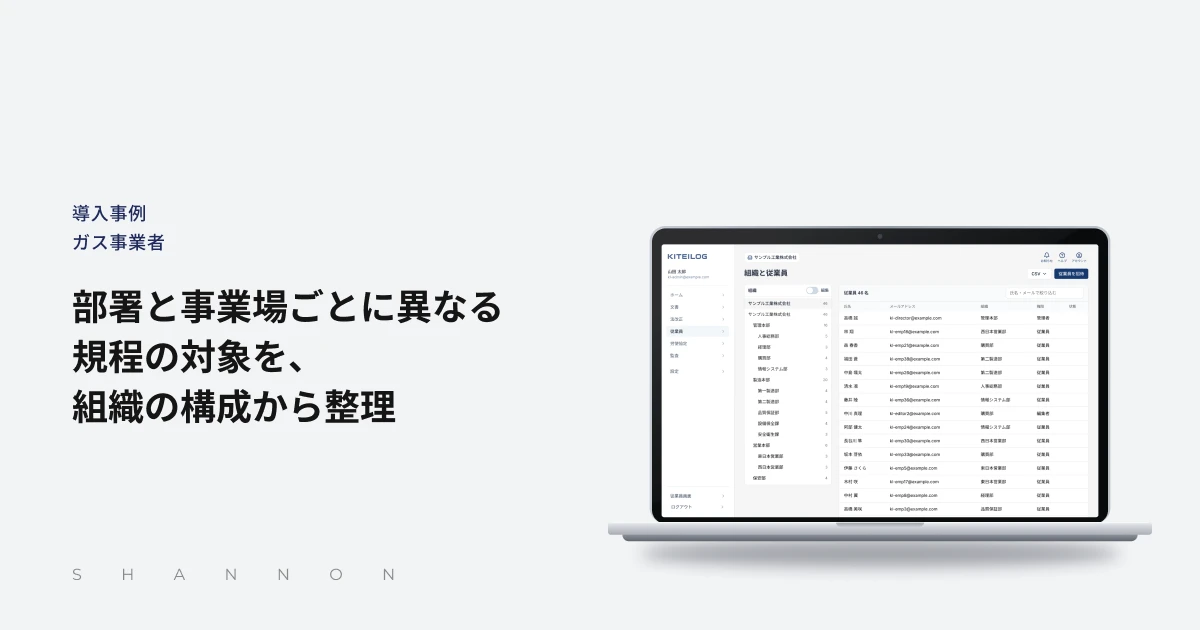
The company registered its departments and workplaces, and three administrators are preparing its work rules, childcare and family-care leave rules, and customer-harassment prevention rules.
Challenges before adoption
- Applicable rules and affected employees differ by department and workplace
- Rule preparation fell to one person and was hard to share
- A structure was needed to review rules steadily as laws change
Results after adoption
- Departments and workplaces registered, with rules organized around them
- Work divided among three administrators, with progress shared on one screen
- Preparing for publication while checking consistency with the law check
| Customer | A gas utility |
|---|---|
| Product | Kiteilog |
| Adopted | June 2026 |
This gas utility supplies gas to homes and businesses. In addition to administrative departments at head office, it has departments that maintain pipelines and inspect equipment, and departments that handle customer inquiries and requests to start or stop supply. Working patterns and duties differ by department, and the company operates from several workplaces, each with its own equipment and staffing.
In such an organization, the employees a rule concerns vary from rule to rule. The company registered its organizational structure in Kiteilog and began preparing its rules around that structure. This is how the work has progressed so far.
Safety work and customer-facing work under one roof
A gas business rests on stable supply and safety. Maintenance of pipelines and equipment and emergency response continue day and night, while inspection visits to customers’ premises and inquiries by phone or at the counter bring many staff into direct contact with customers.
These differences shape how people work. Safety departments need shift and on-call arrangements, while customer service departments work around opening hours. Equipment and staffing differ by workplace, and so do working-hour management and leave.
The company sets its rules company-wide but also needs arrangements that reflect department and workplace circumstances, so it had to sort out which rules concern which departments and workplaces from the drafting stage.
Recent legal changes have added to this, including revisions to support for balancing work with childcare and family care, and growing expectations for employers to address customer harassment.
Some changes require rules to be revised in time for the law to take effect. Knowing which rules to revise, how and by when, and working through them in a planned way, is important both for protecting employees and for meeting the company’s responsibilities.
Rules and organization hard to match
Rules were written as document files and kept by the administrative department. Each rule stated its scope, but there was no way to see in one list which departments or workplaces it applied to.
As rules multiplied and reorganizations accumulated, the mapping became harder to see. Checking which rules applied to a department meant reading each rule’s scope.
The same issue arose when revising rules: changes had to be communicated to affected departments and workplaces, and deciding whom to inform required fresh checking each time, adding work to every revision.
For rules such as customer-harassment prevention, which matter greatly to customer-facing staff, identifying the relevant departments correctly was essential.
A clear mapping also helps employees, who can find the provisions that concern their own department or workplace more easily and understand them more accurately.
Preparation concentrated on one person
Rule preparation was led by one person in the administrative department, often covering drafting, legal research and internal coordination alone, so the work tended to be postponed as it grew.
Splitting the work was hard when files sat on individual computers: no one could tell who was working on what, intermediate versions multiplied, and progress could only be shared verbally in meetings.
Reliance on individual experience was another issue. If knowledge of how rules were written and how department circumstances were handled stayed in one person’s head, handovers would be difficult, and the company’s ability to keep its rules up to date would depend on one individual.
With legal changes continuing, the workload was expected to grow, and relying on one person risked missing effective dates. The company decided to build a structure in which several people could share the work, alongside reviewing the system.
Choosing to organize rules around the structure
The company considered continuing with shared folders, which cost nothing extra but offered no way to record which rules concern which units. A general-purpose document management tool would have required its own conventions to link rules with departments and workplaces.
It chose Kiteilog because rules can be managed after registering departments and workplaces, so the relationship between rules and the organization is recorded in the system rather than in someone’s memory.
Support for multiple administrators was another reason. Several administrators can draft and review on the same screen, and drafts in progress are kept in the same place, making it easier to share who is working on which rule.
The law check was also important. With rules being revised in response to legal changes, comparing articles with current law and amendments was considered essential for accuracy.
During evaluation, the people involved walked through the flow from registering departments and workplaces to drafting rules. Because the work would be done between other duties, clear steps and the ability to pause and resume drafts mattered.
Registering the structure and dividing the work among three administrators
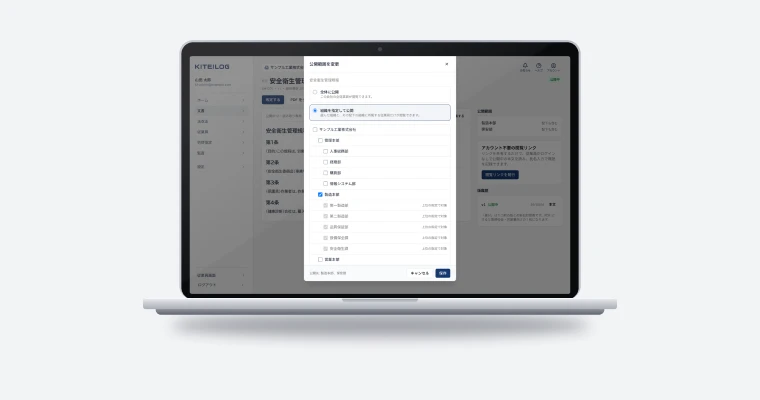
The company began by registering its departments, including administration, safety and customer service, in line with the actual organization, and its workplaces. Drawing the whole organization in the system before drafting provided the basis for everything that followed.
Comparing the organization chart with how work actually flows, the company checked for departments that existed only in name or whose work had changed, bringing its organizational information up to date. This also gave the three administrators a shared understanding of the organization before they started drafting.
It then invited three administrators, moving from one person to a team of three. Each rule has a lead administrator, and the others review the work on the same screen.
Progress that used to be shared verbally can now be seen in Kiteilog, making overlaps and gaps easier to spot. Drafts are in one place, so there is no confusion about the latest version and no need to email files back and forth.
Starting with three rules
Work began with three rules: the work rules, the childcare and family-care leave rules, and the customer-harassment prevention rules. All directly affect how employees work, and all are areas shaped by legal change.
The work rules apply to every employee. Because working patterns vary, the company is separating company-wide provisions from those reflecting department circumstances, and having departments and workplaces registered helps it see which provisions apply where.
For the childcare and family-care leave rules, an area of ongoing legal revision, the law check is used to compare articles with current law and amendments and identify points to review.
The customer-harassment prevention rules are especially important for a utility with many customer-facing roles. To protect counter and field staff, the company is working on procedures for responding to harassment and a system for receiving consultations, using the organizational structure to confirm which departments are involved. Field inspection staff and counter staff face different situations, and the company is considering how the rules should address each.
These are also areas where employees often want to check the rules for themselves, and the company aims to make leave arrangements and where to seek help clear and easy to find.
Publishing each rule once it is ready
The company is now preparing the three rules for publication. After checking consistency with the relevant laws and reviewing them among the administrators, it will publish each one once its preparation is complete.
The approach of organizing rules around the structure will carry over to other rules, so that the scope of each new or revised rule can be confirmed against departments and workplaces.
In an organization where safety work and customer-facing work sit side by side, knowing whom each rule concerns is the starting point for delivering the right rules to employees. With a team of administrators and the history recorded in the system, the company can respond to future legal changes as an organization and continue the work even when people change.
Key features
- Departments and workplaces
- Multiple administrators
- Rule drafting
- Law check