Document generation engine · MCP ready

A document generation engine built on blockchain technology

DocRelay is a document generation engine built on blockchain technology. The hash of every document it issues is chained to the previous record and a daily hash is published, so you can always verify that a document has not been altered after issuance. Merge your data into layouts from the template editor or into your own Excel and Word templates, and issue PDF, Excel, Word or CSV through a single API.

DocRelay screen

Two ways to create templates

Design a layout in the template editor, or upload your existing Excel and Word files as templates.

From issuance to delivery

Receive documents in the response, with a webhook on completion, or through expiring URLs.

Retention and tamper detection

Documents are deleted after the retention period, and issuance is recorded in a tamper-evident log that applies blockchain technology.

Demo

Template editor

The template editor. Issuing the document with the sample data shown in the API tab fills in the merge fields on the page and attaches a tamper-detection record (sample data).

Build it from an AI agent (MCP):https://api.docrelay.jp/mcp

Features

What DocRelay does

Template editor, Excel and Word

In the template editor, place text, lines, rectangles, images, line-item tables and body text, and set merge fields such as {{customer.name}}. Line-item tables continue across pages as rows grow, and body text flows onto the following pages. You can also upload Excel or Word files that contain merge fields and use them as templates.

  • Start from 39 ready-made templates such as invoices, quotes and payslips
  • Excel and Word uploads up to 10 MB
  • Preview with sample data before you publish
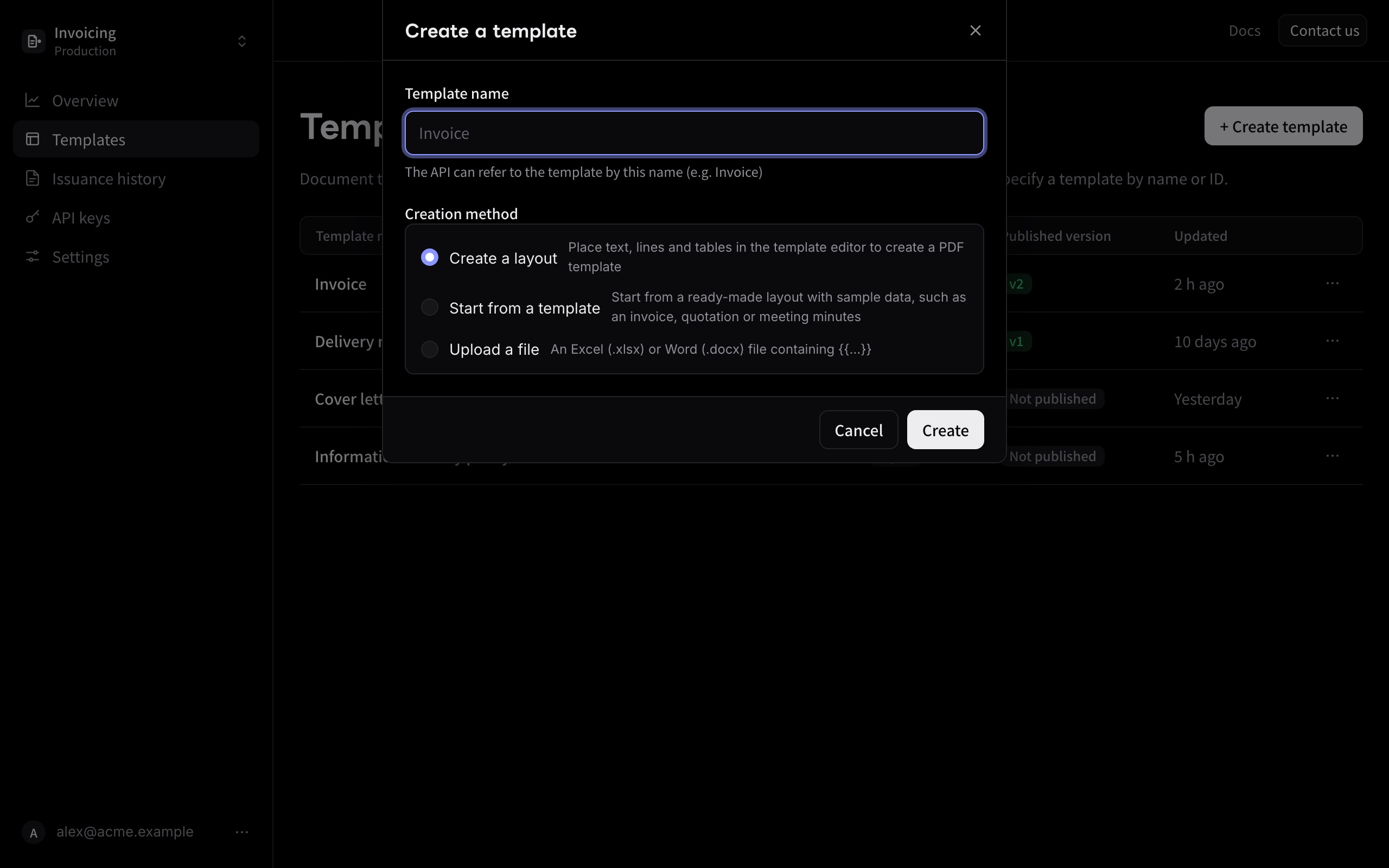
Creating a template in the DocRelay dashboard: create a layout, start from a template, or upload a file

One API call, your choice of delivery

Call the API with the template name, output format and data. If the document is ready within the wait time, it is returned in the response; otherwise you receive an ID and a webhook on completion. Share issued documents through URLs with an expiry and a download limit, or retrieve them again through the API within the retention period.

  • Batch issuance of 1 to 1,000 items, as a zip or one merged PDF
  • CSV encoding (UTF-8 or Shift_JIS), BOM and line endings are configurable
  • A REST API you can call from any language
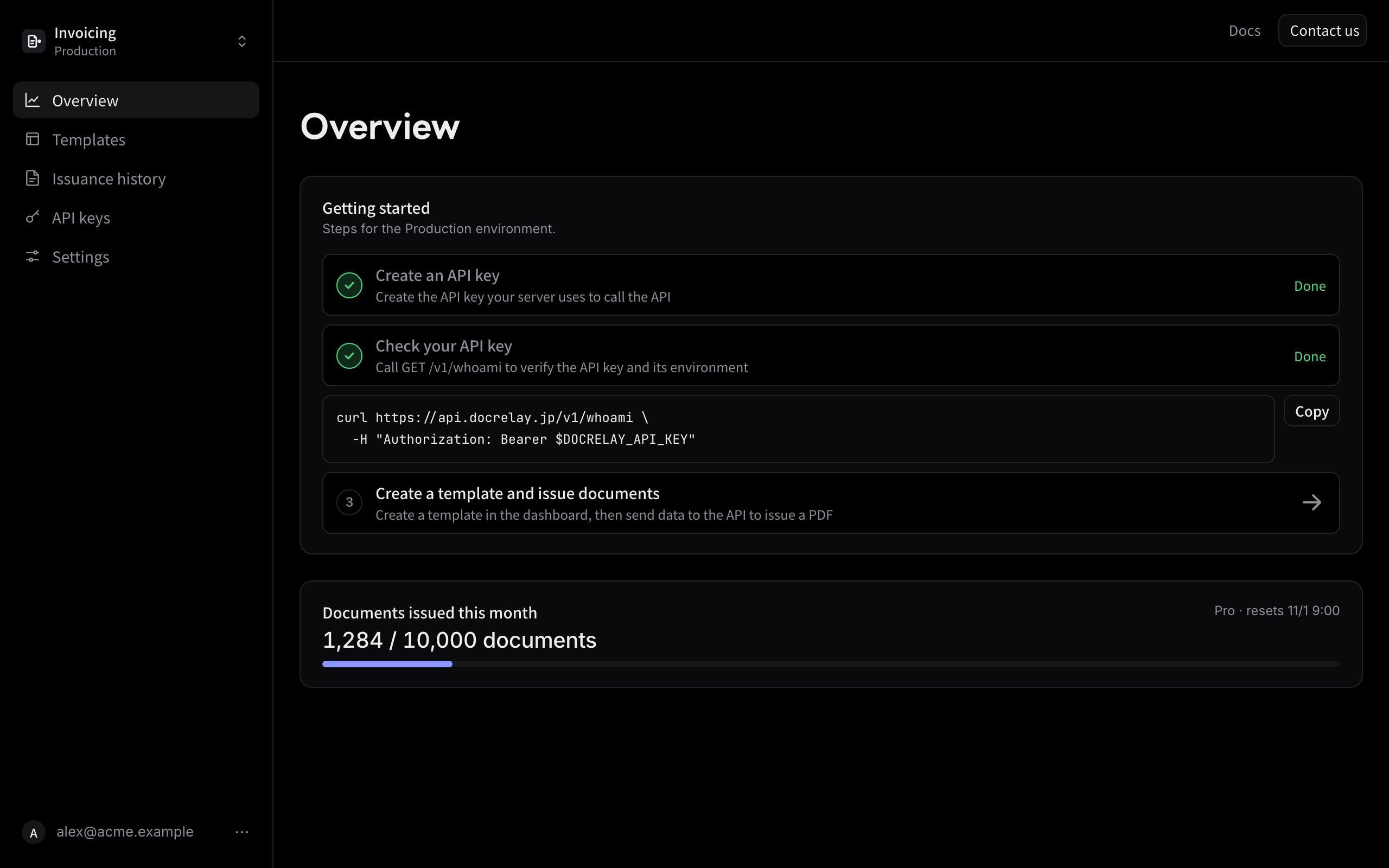
DocRelay project overview: the steps from creating an API key to issuing a document, and this month’s document count

Retention periods and tamper detection

Set a retention period for each issuance (24 hours by default); documents are deleted automatically when it ends. After deletion, only the record, including the hash, size and file name, and the tamper-evident log are kept. The log applies blockchain technology: each document’s hash is chained to the previous entry, and a daily hash is published.

  • Maximum retention of 7 to 180 days, depending on the plan
  • The data you merge is never recorded in the log
  • Verify that a document is unchanged since it was issued
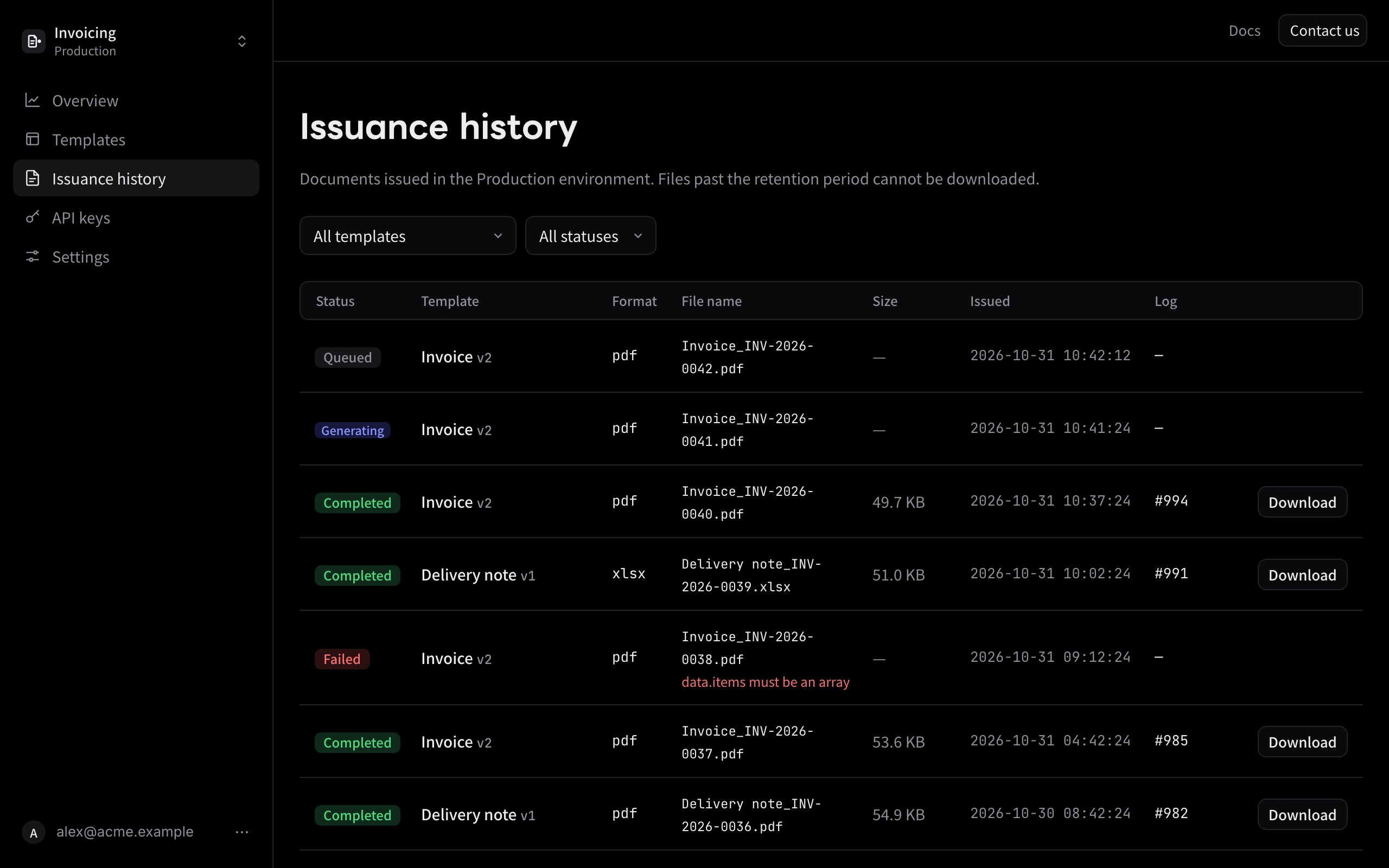
DocRelay issuance history: status, format, file name, size, issue time and tamper-evident log number for each document
Flow

Getting started

From sign-up to production.

  1. Sign up

    Sign up in the dashboard and create an organization and a project.

  2. Create a template

    Design a layout in the template editor or upload an Excel or Word template, and preview it with sample data.

  3. Try it in test

    Issue documents with a test API key. Test keys use the latest version, including drafts.

  4. Go live

    Publish the template version and start issuing with a live API key.

FAQ

FAQ

Layouts from the template editor output PDF, Excel templates output Excel (xlsx) or CSV, and Word templates output Word (docx). Excel and Word are not converted to PDF. Batch issuance returns a zip, or a single merged PDF for layout templates.
If the document is ready within the wait time you set, it is returned in the response. Otherwise the request is accepted with an ID, and a webhook (render.succeeded) is sent on completion. Callers do not need to switch between synchronous and asynchronous handling.
You set the retention period for each issuance; the default is 24 hours, and the maximum is 7 to 180 days depending on the plan. After that, the document is deleted and only the record, including the hash, size and file name, and the tamper-evident log remain.
Issuing in live environments stops for the rest of the month. The limit depends on your plan, as listed on the product site. Test-environment documents do not count, and each item in a batch counts as one document.

Talk to us about DocRelay.

We reply within two business days.