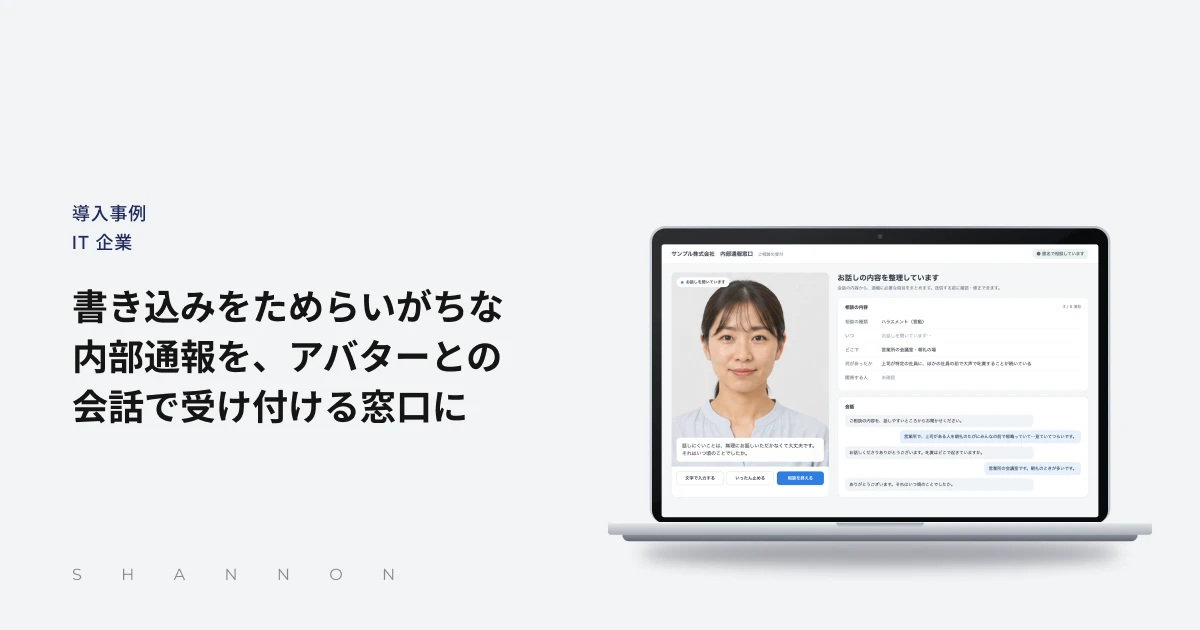
A conversational AI avatar built into a whistleblowing intake lets reporters explain the situation by talking.
Challenges before adoption
- Form-based intake left some reporters unsure what to write or how
- Hesitation about writing things down kept some people from reporting at all
- Building avatar generation and video streaming in-house was a heavy burden
Results after adoption
- Reporters explain the situation step by step while talking to an avatar
- Several avatars are used to suit the tone and purpose of each channel
- Conversation sessions are in ongoing use while the intake flow is refined
| Customer | An IT company |
|---|---|
| Product | avacast |
| Adopted | September 2026 |
This IT company provides a whistleblowing system to companies and other organizations. Its cloud service covers both the intake of reports and the management of how each report is handled, and businesses of many sizes and industries use it as a consultation channel for their employees. Alongside helping clients build systems that meet legal requirements, the company has always treated a channel that people feel safe using as a core part of its product.
Today a reporting channel is expected not only to exist but to be used. The company focused on the moment when people hesitate at the point of writing, and used avacast, an AI avatar API, to build an intake where reporters can make a report by talking with a conversational avatar. This is how that came about.
Accessibility of reporting channels after the law changed
The amended Whistleblower Protection Act took effect in 2022. Businesses that regularly employ more than 300 people are now required to have systems in place to handle internal reports properly, and businesses with 300 or fewer are expected to make efforts to do the same. As a result, more and more organizations of every size are setting up reporting channels.
Putting such a system in place involves more than opening a channel. It also means designating the people who handle reports, protecting reporters from unfair treatment, and setting out the steps from receiving a report through investigation and correction. Whistleblowing systems have come to be adopted as the foundation that supports all of this.
A channel that nobody uses, however, cannot fulfil its purpose of surfacing problems inside an organization early. What is asked of a reporting channel is shifting from whether it exists to whether employees actually find it easy to use.
For a company that provides whistleblowing systems, this shift touched the role of the product itself. Beyond managing reports properly once they arrive, how to offer an entrance that makes the first step easy had become a deciding factor in the product’s value.
Hesitation about writing, a barrier that is hard to see
Most reporting channels are forms in which the reporter writes down what happened. Organizing when, where, who was involved and what took place into written sentences is no small burden.
Some people cannot tell whether what they saw or heard counts as something to report. Others feel that putting it in writing will make it a bigger matter than it is. Faced with the form fields, some do not know where to begin and simply close the page. This kind of hesitation rarely shows up in a channel’s usage figures.
The channel side had its own difficulty. When what is written is fragmentary, follow-up questions are needed to establish the facts. With anonymous reports, however, it is hard to contact the reporter again, and sometimes the review has to proceed without the information it needs.
Lowering the barrier to reporting and reliably gathering the necessary information can look like conflicting goals. The company was looking for a form of intake that could meet both at once.
An intake where people can explain by talking
When people consult someone, they usually sort out their thoughts while talking. If the listener asks questions in order, the person only has to answer them to convey how events unfolded. The company asked whether this natural way of consulting could be brought into report intake.
A telephone line staffed by people has its own difficulties. Some reporters dislike having their voice heard, and phone lines have limited hours. The company needed a way to keep the benefits of conversation while removing the psychological burden of talking directly to a person.
Its answer was to make the conversation partner an avatar. The reporter’s face and voice are not passed on; the reporter talks to the avatar. Having a visible face on the screen makes it easier to start talking than facing a text-only page, and because the avatar asks questions in turn, the necessary information is gathered without gaps.
The design also made sense from the standpoint of protecting reporters. An intake where nobody sees the reporter, yet the reporter does not have to compose sentences alone, matched what a whistleblowing channel requires.
Why an API rather than building in-house
An intake where people talk to an avatar requires many technologies: generating the avatar, streaming its video, synthesizing speech and matching mouth movement to what is said. The company first examined what building these in-house would involve.
Building it alone would allow full control over every detail, but establishing and running a system that streams avatar video without lag is a heavy development burden. There was also concern that it would draw effort away from the reporting and case-handling features where a whistleblowing system provider should be investing.
A general text-based dialogue system was also considered. Because the reporter would still be typing sentences on a screen, it differed little from a form and was judged insufficient to ease hesitation.
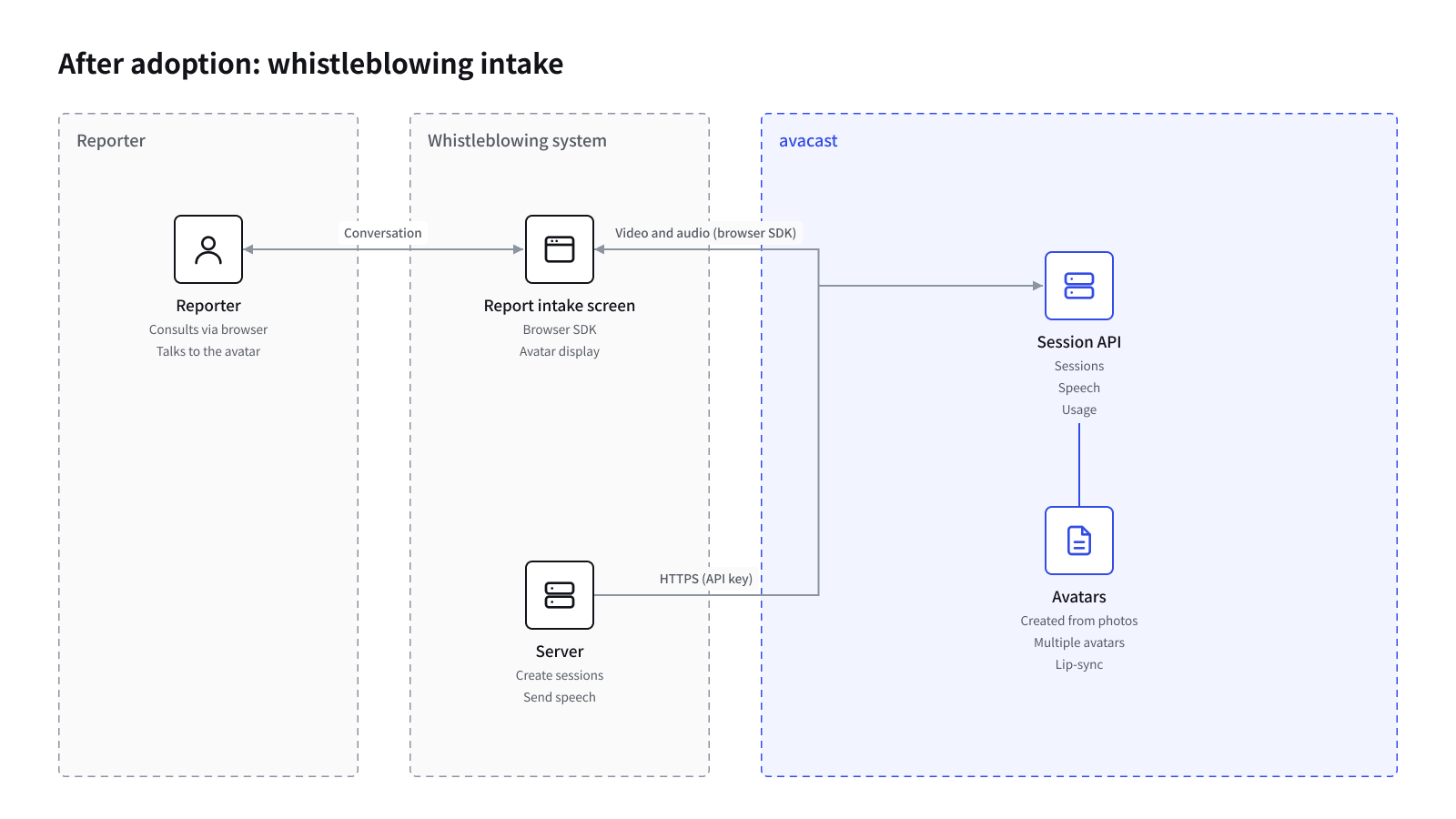
In the end the company chose avacast, an AI avatar API. It valued being able to create avatars from photos and to build real-time conversational avatars into its existing screens with the API and SDK. By leaving the avatar video and voice to avacast, the company could concentrate its development on the flow of the intake conversation and on how received reports are handled.
Building several avatars into the intake screen
The company created several avatars from photos. Whistleblowing channels differ in atmosphere and expected users from one client to another, so it considered it important to be able to choose an avatar that suits the tone and purpose of each channel rather than relying on a single one.
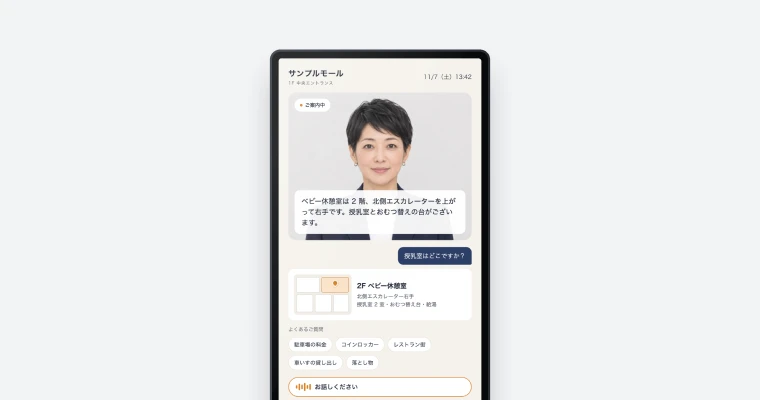
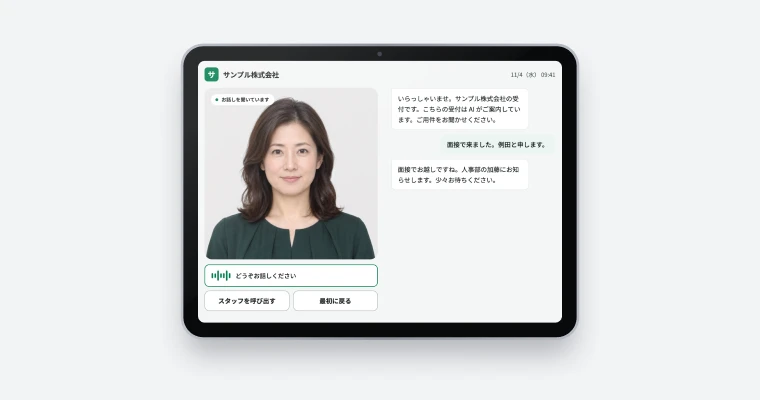
The avatars were built into the report intake screen. When a reporter starts, the avatar appears and asks about the situation step by step through conversation, and the reporter answers while explaining what happened and how.
During the build, the company repeatedly ran conversations based on likely reporting scenarios and adjusted the order and wording of the questions. It checked points specific to whistleblowing intake, such as not rushing the reporter and showing care when touching on difficult matters.
On the operations side, the company uses the avacast usage dashboard to track conversation sessions. Being able to see usage trends provides clues when reviewing the intake flow and helps with ongoing operation.
Explaining the change to client organizations was also an important step. For the staff who run a reporting channel, an intake with an avatar is a new format. Using the actual screen, the company explained that the reporter’s face and voice are not passed on and that what the avatar asks corresponds to the fields of the former form, so clients could renew the entrance without changing how the channel is run.
Designing for the care that report intake requires
Report intake calls for different kinds of care than a general inquiry desk. The company considered the right form for it from both technical and operational angles.
The first priority was the reporter’s sense of safety. The conversation partner is only an avatar, and no one sees or hears the reporter. Making this clear at the start of the intake helps the reporter begin calmly.
The second was keeping the conversation going without interruption. If the avatar’s replies lag or the video breaks up mid-consultation, tension rises and the reporter may give up. Choosing an API built for real-time conversation lets the intake proceed at a natural pace.
The third was the avatar’s appearance and manner. A reporting channel needs to feel both approachable and calm. Letting each channel choose among several avatars created from photos allows this balance to be adjusted for each client.
Each of these points draws on the company’s experience in providing whistleblowing systems. Leaving the avatar technology to avacast while applying its own experience to the intake design made it possible to build the feature in a short time.
A more approachable channel, and the improvements ahead
With the avatar intake, reporters can now explain the situation step by step while talking to the avatar. There is no need to work out what to write or how; answering the questions is enough to move forward, which makes the channel more approachable for people reluctant to fill in a form.
On the channel side, the necessary points are asked in order during the conversation, making reports easier to understand. There is less need to infer the facts from fragmentary entries, and the review after intake proceeds more smoothly. For both the reporter and the channel, misunderstandings at the intake stage have become less likely.
Several avatars are in use, chosen to suit the tone and purpose of each channel. Being able to offer a channel with a different atmosphere for each client broadens what the company can propose, and letting prospective clients experience the avatar intake shows the difference from a form in concrete terms.
The company continues to use conversation sessions on an ongoing basis while refining the intake flow, reviewing where reporters tend to hesitate and which questions should be asked differently. It will also refine how avatars are chosen for each channel and how intake is configured for each client, based on what it learns in operation.
An internal reporting channel is an important way for an organization to notice its own problems early. The company plans to keep developing the avatar intake as an entrance where people can take the first step with confidence.
Key features
- Avatars from photos
- Real-time conversation (API and SDK)
- Multiple avatars
- Usage dashboard