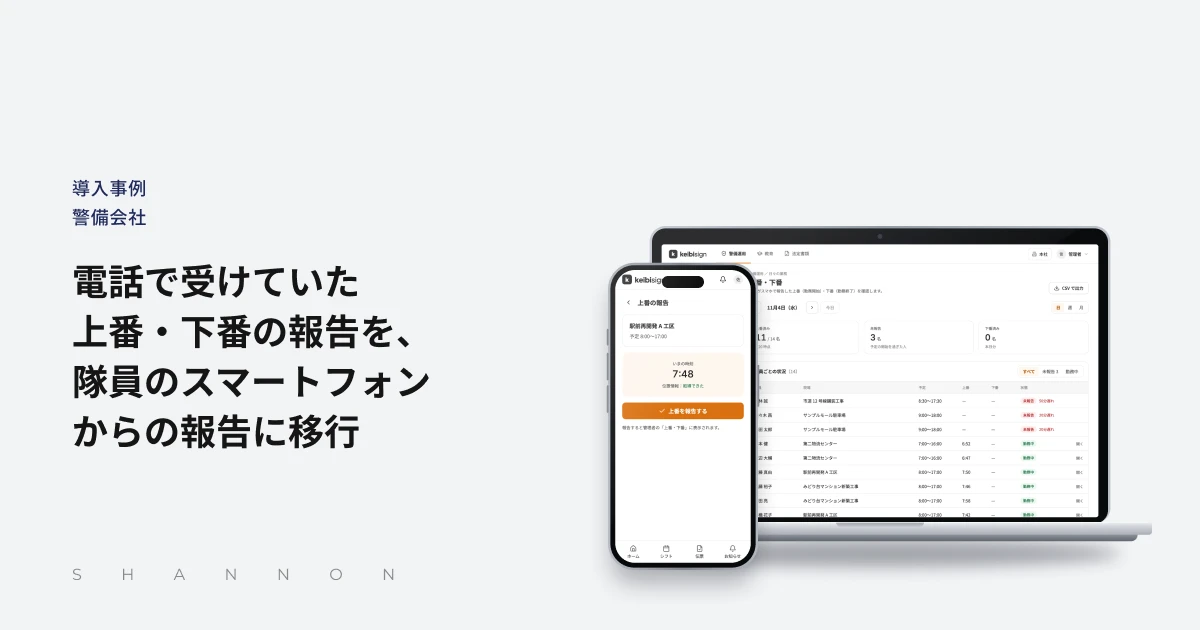
The company is moving start-of-shift and end-of-shift reports, once received by phone and message, to guards’ phones, where each report is recorded with the time and location.
Challenges before adoption
- Shift reports received by phone or message and written down one by one
- Morning and evening calls piling up and holding back other work
- No quick list of who was on duty, so missed reports were noticed late
Results after adoption
- Reports arrive with the time and location and can be checked in a list
- No more taking calls and writing reports down in the morning and evening
- Guards who have not reported are noticed sooner
| Customer | A security company |
|---|---|
| Product | Security Sign |
| Adopted | May 2026 |
This security company provides traffic control, facility security and other services, assigning guards to several sites every day. Start and end times differ from site to site: some begin early in the morning, others run late into the night. The office is responsible for confirming that guards have taken up their posts on schedule and finished their work.
For a long time, that confirmation was done by phone and message. As the number of guards and sites grew, receiving and recording reports became a burden on the office, and it grew harder to keep an accurate picture of the sites. In May 2026 the company adopted Security Sign and is moving start-of-shift and end-of-shift reports to guards’ smartphones. The steps it took are described below.
Why shift reports matter
In security work, a guard taking up a post is the start of a shift, and leaving the site after finishing work is the end. Guards report to the office at both points, and the office uses these reports to know who is at which site.
These reports are more than attendance records. They confirm that the number of guards specified in the client contract is on site at the specified time, and they are a basic mechanism that underpins service quality. If a start-of-shift report does not arrive, something may be wrong: a late arrival, illness or the wrong site.
Receiving reports reliably and keeping them as records is also essential for accountability to clients. When the actual work needs to be verified later, the company must be able to show exactly when each guard started and finished.
The company had made shift reports mandatory for every guard. The issue was not the reports themselves but how they were received and recorded. Report records also feed into totaling hours for payroll and checking client billing, and inaccurate records meant cross-checking again at month-end.
Morning and evening calls, and the limits of handwritten records
Guards called the office or sent a message at the start and end of every shift. Each time, office staff wrote down the guard’s name, the site and the time by hand and reflected it in the day’s list.
Most sites start at set times in the morning and finish in the evening, so start-of-shift reports cluster in the morning and end-of-shift reports in the evening. During those hours, staff were occupied with one call after another and could not attend to other work.
When calls overlapped, guards had to wait to get through, even though they needed to report before starting work. Messages were easier than calls, but staff still had to copy their contents by hand.
Handwritten records had other problems. Because reports were written in the order they arrived, seeing who was at which site meant reading back through the notes, and producing a list of guards on duty was not easy. Missed reports were the biggest concern: noticing that a guard had not reported after the start time took time, and the later it was noticed, the later the follow-up or replacement.
Moreover, the time recorded by phone was the time the report was received, not necessarily when the guard arrived on site, and where the report was made from was not recorded at all.
A system to ease the burden of receiving reports
The company considered standardizing report formats in a spreadsheet and receiving reports through a general-purpose chat tool. Both would still require transcribing reports into records, and neither would make it easy to spot missing reports automatically.
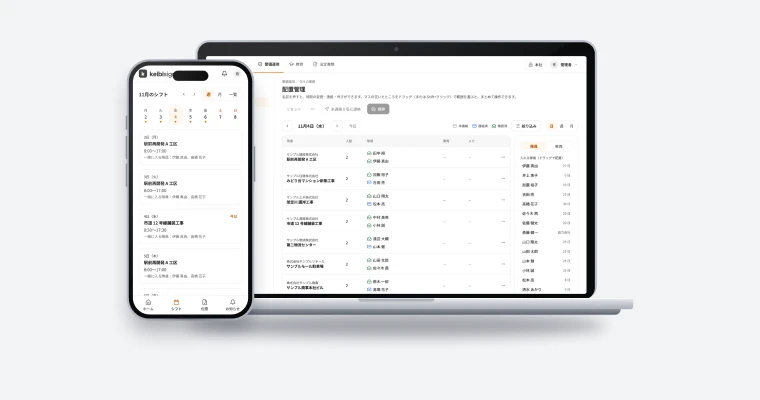
It chose Security Sign, a SaaS for managing security-guard operations. Guards report the start and end of shifts from the mobile app, and each report is recorded with the time and location. The office sees incoming reports in a list, and taking calls and writing them down is no longer necessary.
What the company valued most was that guards could report directly from the smartphones they already use. A simple operation meant the switch would not add to guards’ workload. Because reports appear in a list, it is also easy to see who has not yet reported, and the possibility of later linking reports with assignment data in the same system weighed in the decision.
No special devices were needed either. Issuing dedicated devices would have created new work in managing them and dealing with breakdowns, while installing an app on guards’ phones was something any size of office could manage.
A switchover run in parallel with phone reports
The rollout began by giving guards the app and asking them to send shift reports through it. Rather than stopping phone reports at once, the company accepted both for a period and switched guards to the app step by step as they became comfortable.
Guards were given instructions limited to the reporting operation: open the app, choose start or end of shift, and send. They tried it hands-on, and office staff guided those unsure about smartphones individually.
During the parallel period, the office checked both app reports and phone reports. Guards whose app reports had become routine were told they no longer needed to call, one by one, so that no reports would slip through while the method was changing.
The company also explained to guards how location information is handled: it is recorded at the moment of each shift report and serves to keep an accurate record of the actual work.
The same method for early-morning and night sites
The company’s sites include early-morning traffic control at construction sites, night-time road works and facility security that runs late into the night. Reports at those hours used to be taken by phone by whoever was on duty, and when reports overlapped while few staff were in the office, keeping accurate records was difficult.
With app reports, guards follow the same procedure at any hour. Office staff simply check the list instead of answering calls, which eases the load on night duty, one of the benefits the company had hoped for.
At sites where a guard works alone or far from the office, whether a start-of-shift report has arrived is also a sign that the guard is safe. Having reports recorded with the time, and unreported guards visible in the list, matters for guards’ safety as well.
The company set times and responsibilities for checking the list: staff check it around each start time and contact guards who have not reported. Deciding the checking procedure, not just introducing the system, is what makes missed reports reliably caught.
Changes in reporting for the office and for guards
As app reporting spreads, office work is changing. Reports arrive with the time and location and can be checked in a list, and the morning and evening call load is easing. Guards who have not reported after the start time are noticed sooner, so staff can contact them and arrange a replacement if needed.
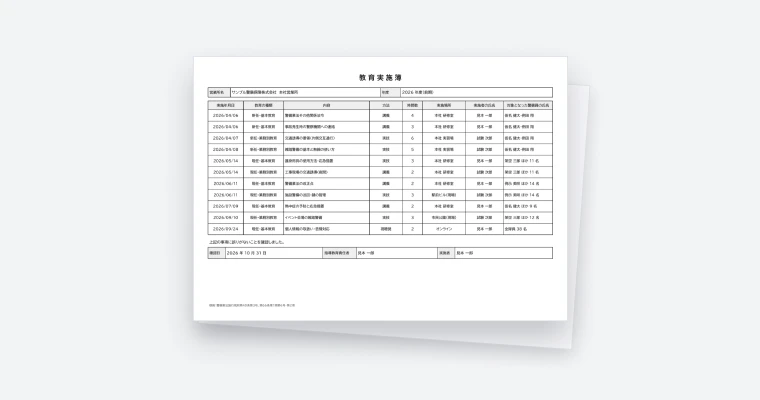
Reports remain as records in the system. When a client asks about the work performed, the company can answer from records of when and where each guard started and when they finished. Receiving reports no longer falls on particular staff, and anyone in the office can see the same information.
Guards benefit too. They used to wait for calls to connect or call back when the line was busy. With the app, a report is complete as soon as it is sent, so they can start preparing on site right away, and errors from mishearing are less likely.
Expanding to assignments and job slips
For now, the priority is to establish app reporting for every guard. Guards who still report by phone will continue to receive individual guidance, and new guards will learn the app procedure during their induction training so that they report the same way from the start. Once the method is unified, the double-checking needed during the parallel period will no longer be necessary.
The company then plans to extend its use of Security Sign, starting with creating assignments in the system so that guards can check their own schedules in the app and reports and assignments can be managed in one flow. It also intends to move on-site job slips to electronic form. By handling shift reports, assignments and job slips in the same system, the company aims to gather site information in one place and achieve both office efficiency and higher service quality.
Key features
- Shift start / end reports
- Report list
- Guard assignments
- Mobile app