The company is bringing initial and in-service training records and the guard roster into one system, so they can be output in the statutory format at any time.
Challenges before adoption
- Training records split between paper logs and spreadsheets
- Records gathered and reformatted before every on-site inspection
- Document preparation dependent on particular staff members
Results after adoption
- Guard details, qualifications and the annual training plan registered
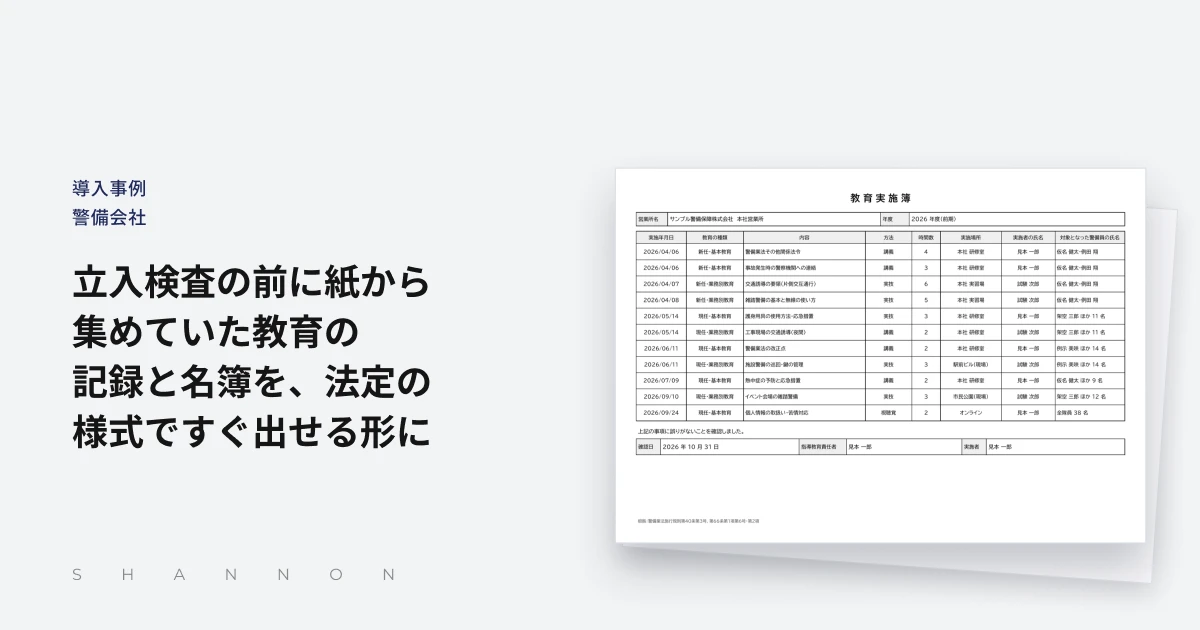
- Training recorded as it happens and output in the statutory format
- The same procedures continue even when the person in charge changes
| Customer | A security company |
|---|---|
| Product | Security Sign |
| Adopted | May 2026 |
This security company provides guarding services at facilities, construction sites and elsewhere, sending guards out to sites every day. Security is an industry in which the law sets out in detail how guards must be trained and which documents an office must keep. Alongside running its sites, the company has consistently carried out training and kept records of it.
Training records and the guard roster, however, were split between paper and spreadsheet files, and each time an on-site inspection by the Public Safety Commission approached, the records had to be gathered and put in order. In May 2026 the company adopted Security Sign and began building a setup in which training records and the roster are kept in order as part of daily work. This case follows the company from preparation to the start of operation.
Training and documents required by the Security Services Act
The Security Services Act requires security companies to train their guards and to keep documents, including records of that training. Newly hired guards must receive initial training, current guards must receive in-service training periodically, and the content, date and instructor of each session must be recorded.
Offices must also keep a guard roster listing each guard’s name, date of birth, period of employment, qualifications and other details. The guidance plan that sets out the training schedule and the training log that records what was carried out are also documents to be managed at the office.
These documents are checked during on-site inspections by the Public Safety Commission. Missing records or formatting errors can lead to administrative guidance. For a security company, carrying out training reliably and recording it in the correct form are preconditions for staying in business.
The company took these legal requirements seriously and had kept up the training itself. The issue was how to turn completed training into records and keep them ready to present at any time.
Training records are not only for inspections. When it is clear which guard has received which training, the records also inform decisions about whom to assign to a site. Putting the records in order was both a legal matter and a way to strengthen the foundation of service quality.
Scattered records and repeated gathering before inspections
The company recorded training in a paper log, while guard details and qualifications were kept in a spreadsheet. Instructors wrote entries in the log, and office staff cross-checked them against the spreadsheet roster as needed.
This meant information about the same guard lived in several places. Hires, departures and new qualifications had to be reflected in the roster, and each training session had to be written in the log, as separate tasks. When updates fell out of step, the roster and the log no longer matched.
Document preparation also depended on particular staff. Only a few people knew which file held which information and which format was required, and there were concerns about whether the same quality could be maintained when they were away or reassigned.
The heaviest burden appeared in preparing for inspections. As an inspection approached, staff gathered records from the paper log and the spreadsheet roster and reformatted them to the statutory forms, checking one by one for gaps, mismatches and missing items, all alongside their regular work.
The company came to the view that, rather than gathering records again before each inspection, it needed a system in which records fall into place through daily work. If records were kept at the moment training took place and statutory forms could be output from the same information as the roster, the pre-inspection work itself would disappear.
One system from training plan to output
The company considered reworking its spreadsheet templates and using a general-purpose document management tool. Neither would reduce the effort of entering records or remove the work of fitting them to statutory forms, and linking guard details to training records would remain difficult. Building its own system in-house was also considered, but developing and maintaining output in the statutory formats was not realistic.
It chose Security Sign, a SaaS for managing security-guard operations. The company valued being able to handle guard details and qualifications, training plans and records, and statutory forms such as the guard roster and training log in one system. Because documents are output in the statutory format from recorded data, there is no need to copy records into forms.
What mattered most was that recording could fit naturally into daily work. Being able to record training right after it takes place, and having roster details entered once and reflected in training records and forms, were essential to improving accuracy without adding work.
Security Sign also covers daily operations such as assignments and shift reports. Being able to start with training records and the roster and extend to other work later was another reason for the choice.
Preparation that started with guard details and qualifications
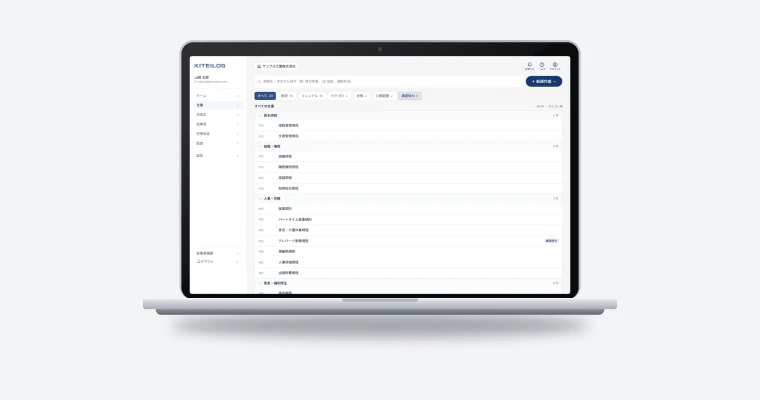
The first step was registering guard details and qualifications. Based on the spreadsheet roster, staff entered each guard’s basic information and qualifications into the system.
This also became an opportunity to review the existing roster. Outdated entries and items whose qualification expiry dates needed checking were identified and brought up to date, on the view that starting from correct data would make all later records more reliable.
Next, the annual training plan was entered. For initial and in-service training, the company registered when and what kind of training would be held, so that the schedule could be seen in a list. With the plan visible on screen, instructors and office staff now share the same schedule.
This preparation was led by office staff. Rather than moving all past paper records at once, the company prioritized the details of current guards and the training still to come.
Switching to recording each session as it happens
Once preparation was complete, the company switched to recording each training session in the system as it took place. After a session, the instructor records the date, the content and the guards who attended. Because records are linked to roster details, each guard’s training status can be seen on the same screen.
Instructors received careful explanations. The recording steps were shown, and for the first few sessions office staff checked the entries together with the instructor, so that those used to the paper log could move to the new method without strain.
The company also standardized how training content is described, so that sessions of the same type are recorded in the same terms and can be compared later. It decided who updates the roster, and when, whenever a guard is hired, leaves or obtains a qualification, tying roster updates to HR procedures so that outdated details do not linger.
Operation has only just begun, and records in the system are still accumulating. Even so, now that records are kept at the time training happens, a form that does not require gathering records afterward is taking shape.
What being ready in the statutory format changes
With records collected in the system, the company now has a setup in which the guard roster and training log can be output in the statutory format. Gathering records from the paper log and roster and reformatting them before an inspection is expected to become unnecessary.
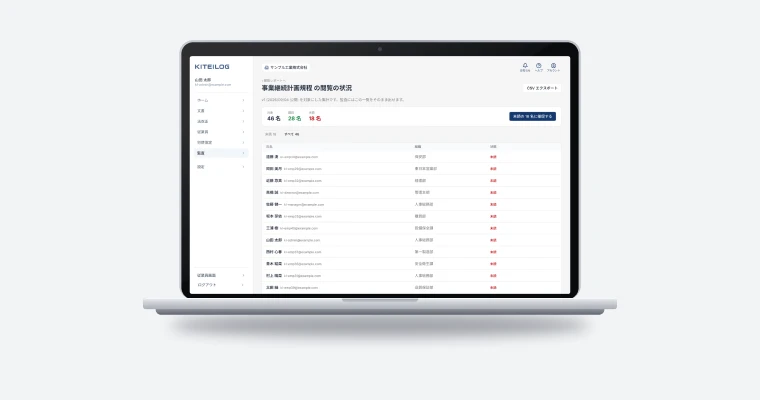
Because training status can be seen in a list, the company can check whether training is on schedule and whether any guard has yet to attend without waiting for an inspection. Noticing gaps early matters for keeping records accurate.
With records and procedures gathered in the system, management can continue in the same way even when the person in charge changes. Know-how about preparing documents that only certain staff held is now shared as a system, reducing reliance on specific individuals.
Instructors no longer need to write in a paper log and bring it to the office. With descriptions standardized, checking entries is lighter for office staff, and communication between instructors and the office has become simpler.
Looking toward daily operations
For now, the company will focus on firmly establishing the management of training records and the roster. As records build up over time and statutory form output is used repeatedly in practice, the procedures will be refined further.
How to handle past paper records is still under consideration. New records are kept in the system, while past logs that must be retained remain on paper and can be referred to as needed. Once enough records have built up in the system, the company will revisit how to treat the older ones. It also intends to review the guidance plan in the system each year, using the previous year’s results to plan the next.
Beyond that, the company is considering using the system for daily operations such as creating assignments and receiving start-of-shift and end-of-shift reports. Handling training records and the roster in the same system as assignments and attendance would let it run sites and maintain statutory documents as one. The company intends to use the system to support the basics: training guards reliably and recording it correctly.
Key features
- Guard details and qualifications
- Training plans and records
- Statutory form output
- Guard roster