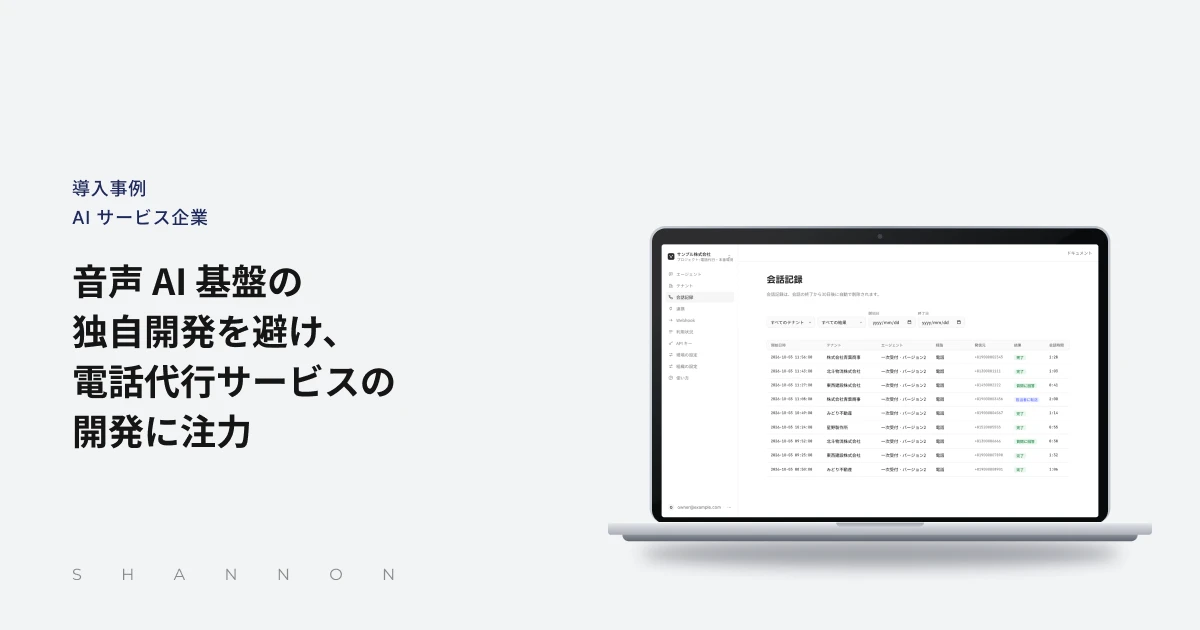
voicast, a voice AI agent platform, handles the calls for this business phone-answering service, from incoming call to conversation and summary.
Challenges before adoption
- Phone answering needs speech recognition, response generation and synthesis
- Building phone-line connection and recording in-house would dominate development
- Each client’s own greeting and handling had to run on one system
Results after adoption
- The AI answers in the client’s name and notifies the right person
- A tenant per client company holds its greeting and handling settings
- Development focuses on service features such as greetings and call notices
| Customer | An AI services company |
|---|---|
| Product | voicast |
| Adopted | October 2026 |
This company provides an AI phone-answering service for businesses. When a call comes in for a client company, the AI answers in that company’s name, takes down the caller’s business and lets the right person know. It is used by small businesses that cannot spare someone to mind the phone and by small teams that are often out of the office.
Human answering services have long existed, but cost and limited hours kept many businesses from using them. To meet this need with AI, the company chose not to build its own voice platform and adopted voicast, a voice AI agent platform. Here is the thinking behind that choice and how the service was put together.
Phone answering for businesses with no one to mind the phone
In small companies, answering the phone often crowds out other work. Staff are frequently out on sales calls or on site, and calls go unanswered. A missed call can mean a missed message from a business partner or a lost inquiry from a new customer.
Hiring someone just to answer the phone is a heavy cost for many small businesses. Some forward calls to mobile phones, but it is hard to take calls while travelling or in meetings, and even when answered, there is little chance to note the details calmly.
A phone-answering service must answer on the company’s behalf, take down the caller’s business correctly and pass it on reliably. To the caller, the voice that answers is the company’s front desk. Answering in the company’s name and taking messages politely bears directly on the client’s reputation.
The company reasoned that AI could answer at any hour while keeping client costs down, but only if it could approach the quality of a human answering service. The AI also had to be accepted naturally by callers as the client’s front desk. If replies were awkward or the AI talked over callers, the client’s image would suffer. Service quality depends on the accumulation of small behaviours in each conversation.
The weight of building a voice platform from scratch
A service in which AI answers calls depends on many technologies: speech recognition to turn speech into text, a way to compose replies that follow the conversation, speech synthesis to give those replies a natural voice, and connection to phone lines and call recording.
Each is a specialist field, and combining them into a working phone conversation requires still more tuning. When to start replying after the caller finishes, stopping when the caller starts speaking, asking again when something was not caught: these small behaviours shape the impression a call leaves.
Operations are demanding too. Calls arrive at any hour, so the voice platform must always run reliably. An outage means the client’s front desk stops working for as long as it lasts. Owning the platform would mean taking on its monitoring and maintenance indefinitely.
Building it all from scratch would have consumed most of the company’s development and operations effort, leaving too little time for the answering service itself. The company wanted to invest instead in what matters to clients, such as greeting settings, how calls are reported and how messages are summarized.
One platform from incoming call to summary
The company compared several approaches. Sourcing speech recognition, response generation, speech synthesis and phone connection separately and combining them allows free choice of parts, but the company would have to maintain the quality and stability of the whole, leaving a burden close to that of building it alone.
It chose voicast, valuing above all that incoming calls, conversation and call summaries run on one platform. By leaving recognition, synthesis, phone connection and recording to voicast, the company can concentrate on the features of its answering service.
voicast’s agent settings were another reason. A greeting, the items to collect, answers to frequent questions and conditions for handing off to a person can be set per agent. Having the elements of phone answering already organized as settings helped the company design its service.
Built-in behaviours that support natural conversation also mattered, such as stopping when the caller starts to speak. Natural responses determine whether callers can state their business without feeling uneasy about talking to AI.
Registering pronunciations was essential as well. Client company names and product names often have unusual readings, and a front desk that cannot say the company’s name correctly will not be trusted. Being able to set pronunciations per client keeps greetings accurate.
A tenant per client for greetings and handling
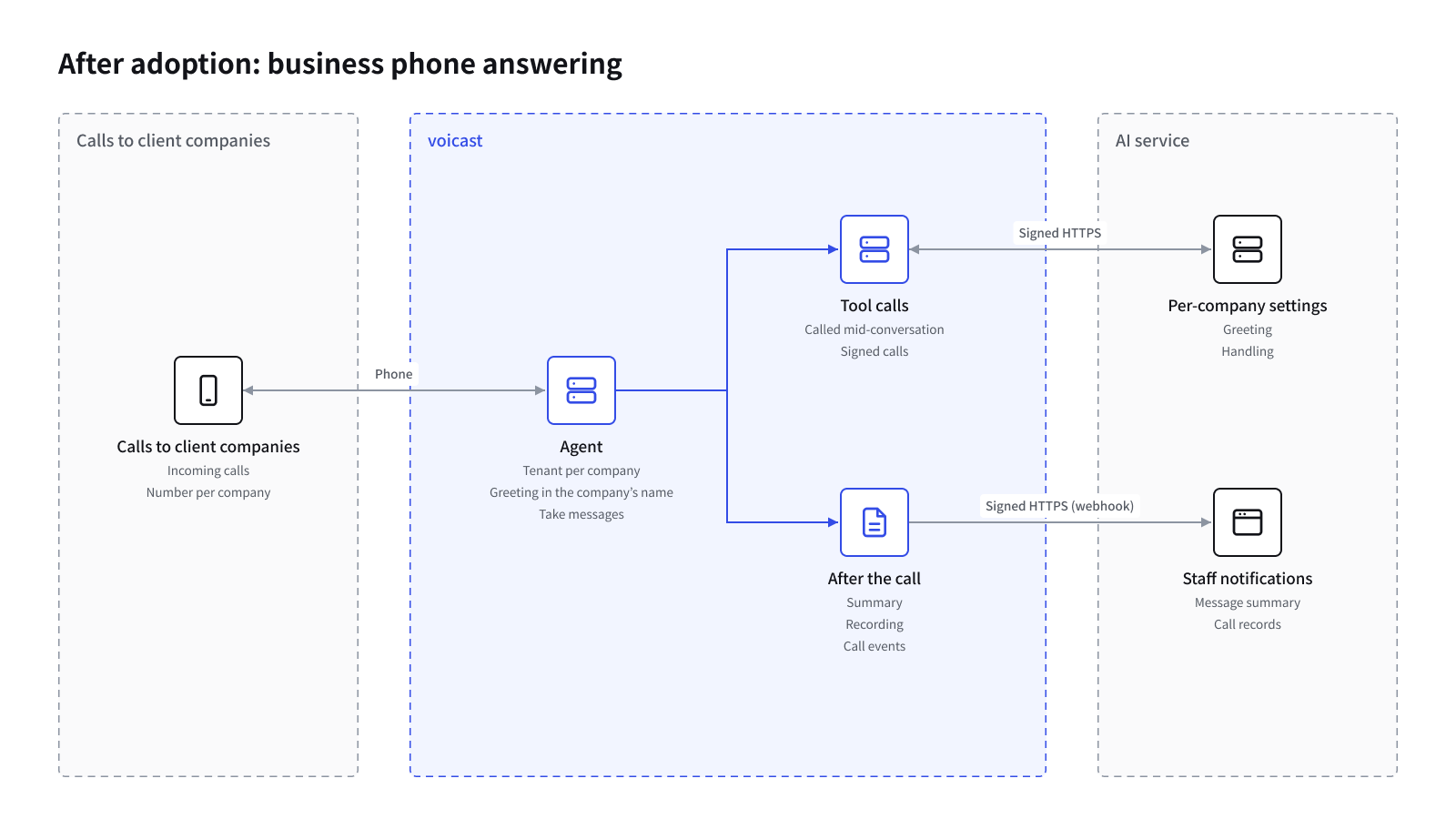
Each client company has its own name to announce and its own kinds of calls. The company creates a voicast tenant for each client, so that each one’s settings and call records are kept separate.
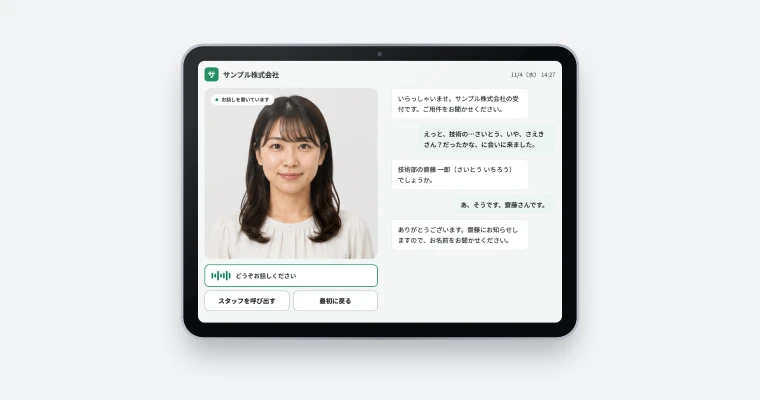
Greetings and handling are set per tenant. The AI answers with the client’s name and takes the caller’s business as that company’s front desk. The items to collect include the caller’s company, name, contact details and purpose, so that everything the right person needs is captured.
Frequent questions vary by industry. Some companies get many calls about hours or location, others about whether a particular person is available. Setting answers to frequent questions per client lets the AI answer what it can on the spot and take messages for matters that need a person’s judgment.
Clients who want to change their greeting or handling can do so from the company’s service screen. Changes apply only to that client’s tenant and do not affect any other client.
As the number of clients grows, the same steps apply: create a tenant and set the greeting and handling. Not having to build anything custom for each client is a major advantage for scaling the service.
Getting messages to the right person with summaries and notices
Answering is only half of the job. The message must reach the right person in a form they can act on.
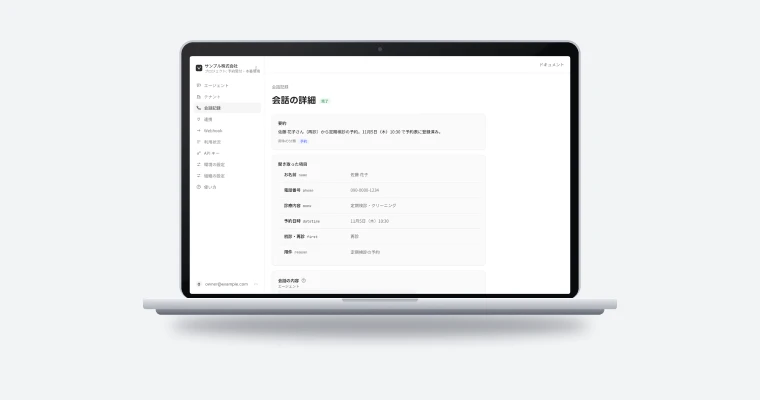
voicast produces a summary when each call ends. Based on this summary, the company’s service notifies the responsible person of who called and why. They can grasp the message and decide whether to call back without listening to the call.
Calls are recorded, so when a summary is not enough or nuance matters, the recording can be checked. Having both a summary and a recording lets people receive messages accurately.
This summary-and-notice flow is where the company put particular effort. From the recipient’s point of view, what matters is who called, about what and whether it is urgent, so the items collected and the notice display were designed together to answer those questions. Leaving the voice platform to voicast freed time for exactly these client-facing details.
Testing before launch, and a shift in development focus
Before launch, the company ran many simulated calls in a test environment: callers who state their business clearly, callers who correct themselves, callers who give their name quickly, callers who start talking before they know what they want to say.
Based on the results, it adjusted greeting wording, the order of questions and answers to frequent questions, using as its yardstick whether a caller could state their business to the client’s front desk without feeling anything was off.
Since launch, the AI has been answering in each client’s name, summarizing the caller’s business and notifying the right person. Clients no longer miss calls while out of the office. They no longer have to take calls while travelling or in meetings, and can read the summary when free and call back as needed.
Development has changed too. With recognition, synthesis and phone connection handled by voicast, the company’s development focuses on answering-service features such as greeting settings and call notices. New features rarely require touching the voice layer, so client requests can be turned into features quickly.
Handling tailored to each industry
The company plans to expand handling settings tailored to each client’s industry, preparing settings based on the calls and questions common in each so that clients can start with appropriate handling from day one.
It will also review summaries and notices based on client feedback, aiming to make the path from receiving a notice to calling back shorter and clearer. With the voice platform in voicast’s hands, the company can keep investing in these client-facing improvements, helping businesses without someone to mind the phone keep the quality of their front desk.
Key features
- Voice AI agent
- Tenants (one per company)
- Inbound calls
- Call summaries