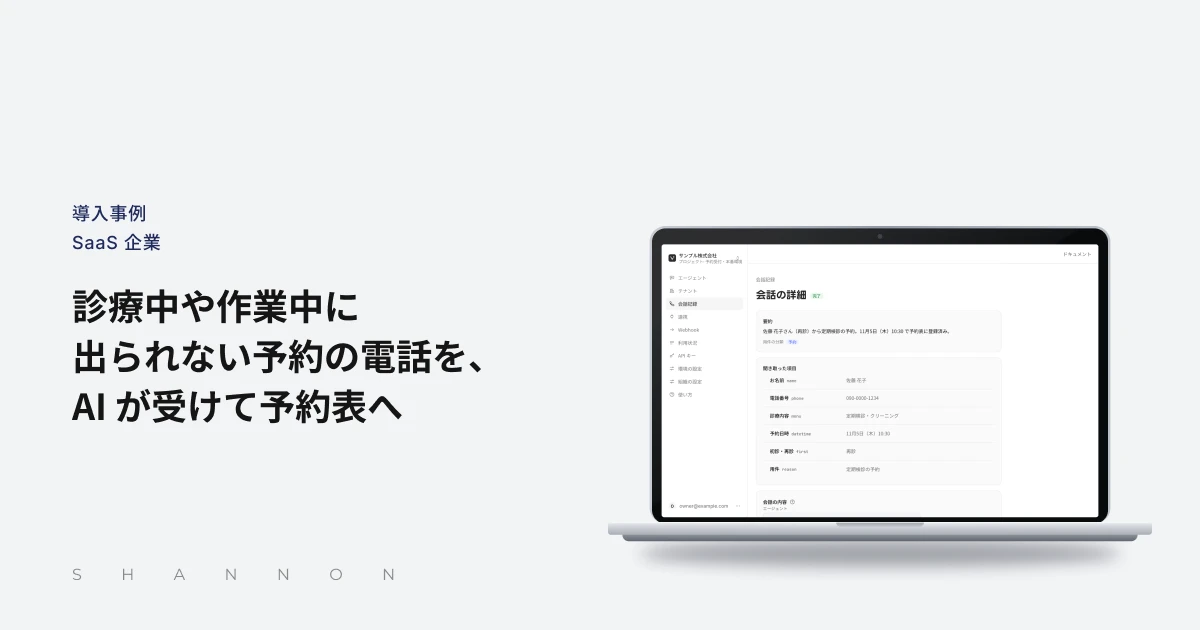
voicast, a voice AI agent platform, handles booking conversations in the AI phone reception of a booking and shift management SaaS. The AI checks open slots and registers the booking during the call.
Challenges before adoption
- Booking calls went unanswered during treatment or work, losing bookings
- Bookings taken by phone had to be copied onto the booking board by hand
- Building speech recognition and phone-line connection in-house was heavy
Results after adoption
- The AI checks open slots mid-call and puts the booking straight on the board
- A summary of each call reaches staff so they can review it right away
- Clinics and shops handle booking calls without interrupting their work
| Customer | A SaaS company |
|---|---|
| Product | voicast |
| Adopted | October 2026 |
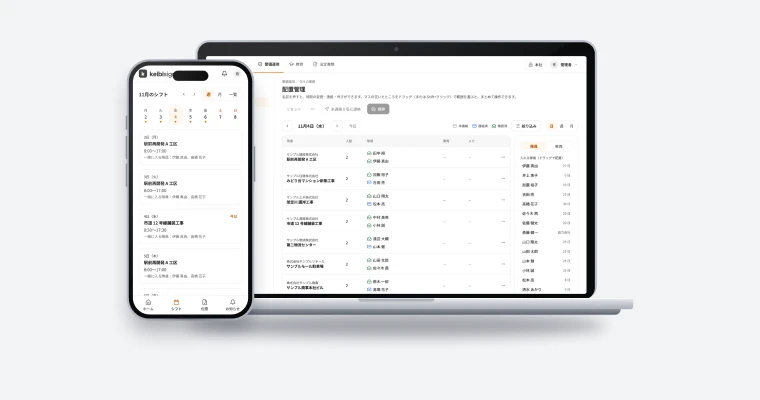
This company provides a cloud service for managing bookings and staff shifts at dental and medical clinics, car repair shops, tire stores and similar businesses. Because the booking board, staff shifts and web booking are handled in one system, it has spread mainly among clinics and shops run by small teams.
The company’s next step was taking bookings by phone. Many bookings still arrive by telephone, yet clinics and shops have many moments when nobody can answer. The company adopted voicast, a voice AI agent platform, and built into its service a feature in which AI answers booking calls and registers the bookings on the board. This is how it came about.
Booking calls that arrive when hands are busy
At dental and medical clinics, reception staff answer the phone between patients. When treatment is busy, or staff are dealing with payments or arriving patients, calls go unanswered. Asking dentists, doctors or hygienists to stop treatment to take a call is not desirable either.
Repair shops and tire stores are in a similar position. While mechanics are working, it is hard to pick up the phone with oily hands, and small shops can have periods with nobody free to answer. In peak seasons such as tire changeovers, the number of calls rises sharply.
An unanswered call may be a lost booking. Some callers try again, but others book somewhere else. Missing booking calls translates directly into lost business.
Bookings taken by phone also had to be re-entered on the board by whoever took the call. Looking for an open slot while on the phone, taking notes, then registering the booking after hanging up left room for mishearing and missed entries. Even with the board in the cloud, phone booking still depended on manual work.
What it takes to offer phone booking as a SaaS
In the company’s service, web bookings appear on the board automatically, while phone bookings were taken outside the service and entered afterwards. For clinics and shops that receive many bookings by phone, bringing this part into the system made a big difference to the service’s value. However widely web booking spreads, many people still prefer the phone, whether to discuss times or because they are not comfortable with screens.
For AI to answer calls and take bookings, many technologies are needed: speech recognition, response generation that follows the conversation, speech synthesis and connection to phone lines. Phone conversation also calls for fine behaviour, such as stopping when the caller starts speaking or asking again when something was not caught.
Building and operating all of this from scratch would be a heavy burden. The company’s development strength lies in business systems such as the booking board and shift management, and devoting most of its effort to a voice platform would slow improvements to the service as a whole.
The company therefore decided to leave the voice layer to a specialist platform and concentrate on the booking side. It also considered sourcing speech recognition and synthesis separately and combining them, but judged that keeping the quality of the combined whole would be nearly as burdensome as building it alone.
Checking the board mid-conversation was decisive
The main reason for choosing voicast was its tools feature, which calls external systems during a conversation. On a booking call, the system must check whether the requested time is free and, if so, register the booking on the spot. If the conversation and the board are disconnected, a booking cannot be completed by phone.
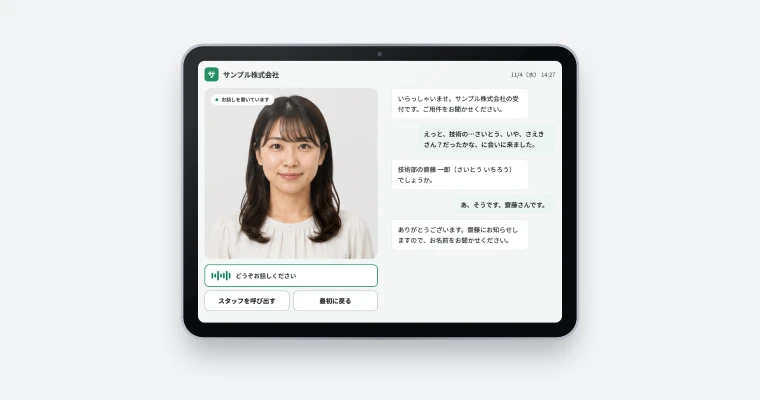
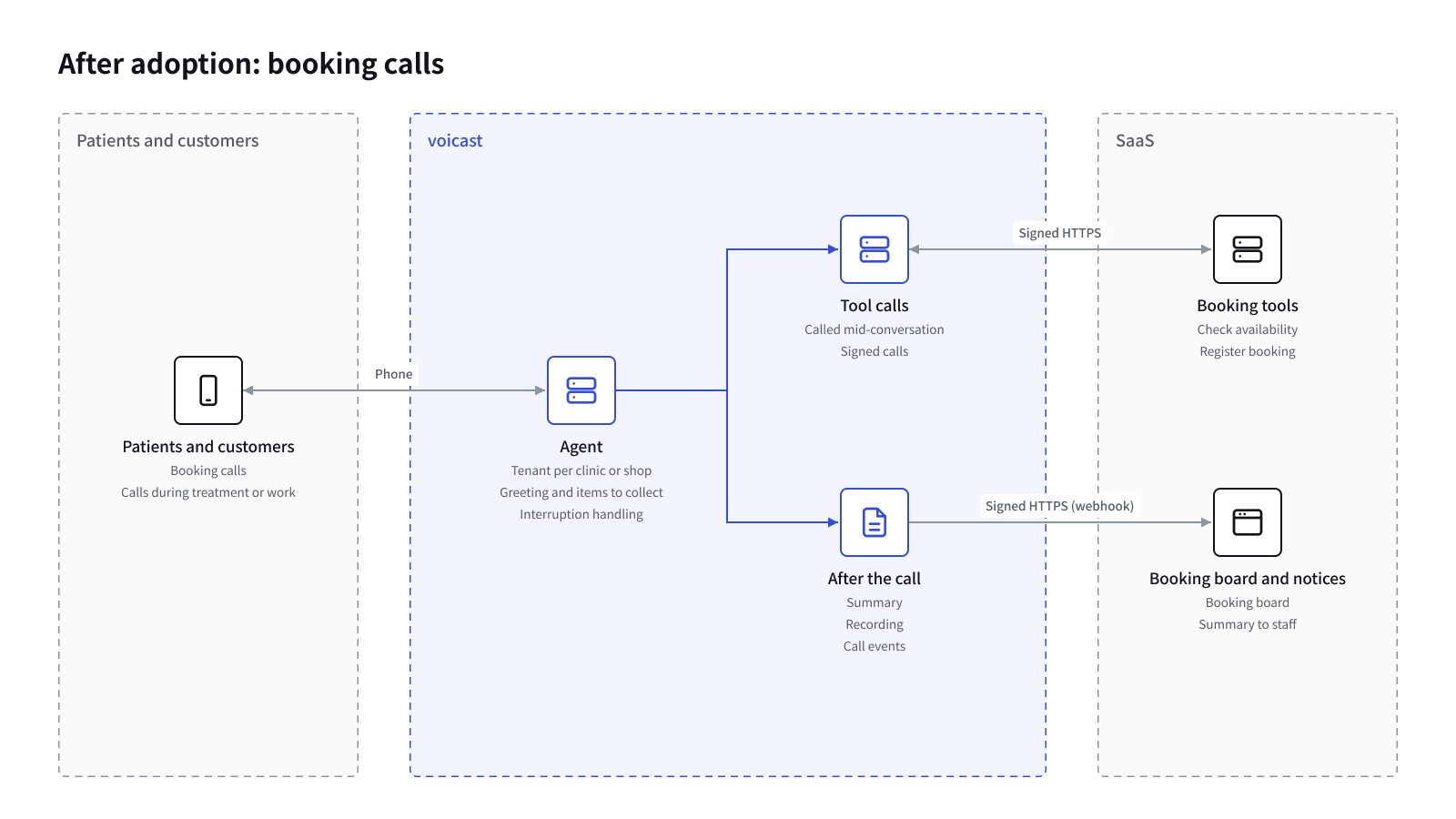
With voicast tools, the agent queries the company’s service mid-call and checks open slots. If the requested time is taken, it offers alternatives, and when the caller agrees, it registers the booking. The company valued being able to complete the whole booking process within a single call.
Handling everything from incoming call to conversation and call summary on one platform was another reason. Because a summary is produced after each call, staff can review what was booked without listening again.
The company also valued the features that support natural phone conversation, such as stopping when the caller starts to speak and registering pronunciations for names and specialist terms. Reading out the names of clinics, shops and menu items correctly was essential for a booking line.
A tenant per clinic or shop, and the booking flow
The service is used by many clinics and shops, each with its own name, treatment or service menu and hours. The company creates a voicast tenant for each clinic or shop, so that each one’s settings and conversation records are kept separate from the others.
Each agent is configured with a greeting, the items to collect for a booking, answers to frequent questions and conditions for handing off to staff. The items include the caller’s name and contact details, the menu item they want and the preferred date and time.
When a slot check is needed, the agent queries the service through a tool. The service returns open slots based on each clinic’s or shop’s hours and existing bookings, and accepts the registration. The booking data stays in the company’s service, and voicast refers to it during the conversation, so the accuracy of bookings is maintained on the service side.
Some calls are not about bookings, or need a human judgment. Handoff conditions are set for those cases, and the call summary lets staff understand what was asked.
Callers often correct themselves or start speaking while the agent is still talking. voicast stops and listens when the caller begins speaking, so the conversation continues smoothly even when a caller wants to add something.
Testing before rolling out to clinics and shops
Before launch, the company ran conversations for both clinics and shops in a test environment, checking cases one by one: the requested time is free, it is not, the caller misstates a menu item, the caller changes their mind midway.
It paid attention to industry differences. Clinics ask different things depending on whether a patient is new or returning, while for repair shops and tire stores the time needed depends on the vehicle and the work. These differences were absorbed through per-tenant settings and the menu information held in the service.
With the flow confirmed, the company began offering the feature to clinics and shops. It explained how the AI answers calls, how bookings it takes appear on the board and how to check summaries.
Some staff were initially uneasy about AI answering the phone. The company explained carefully that bookings taken by AI appear on the board just like those taken by staff, so daily work would not change much.
Phone booking connected to the board and summaries
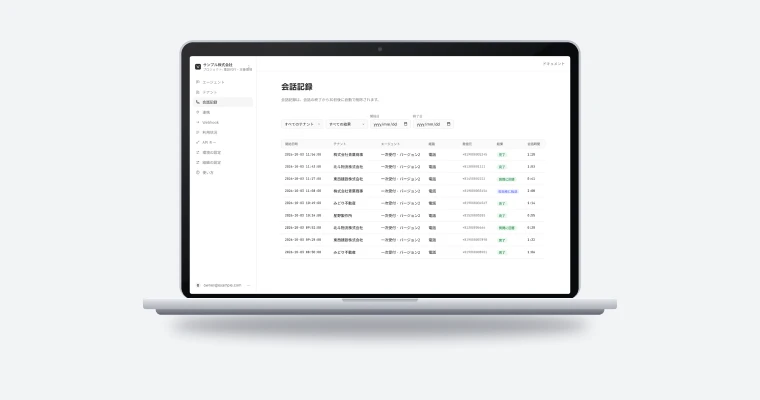
Bookings taken by phone now go straight onto the service’s booking board. Staff no longer note down calls and re-enter them, and there is less room for mishearing or missed entries.
Call summaries reach the responsible staff, who can check what was booked and what was asked as soon as they have a moment. Understanding a call without listening to all of it is a real help to busy clinics and shops, and because summaries also cover inquiries that did not lead to a booking, calls that need a callback are less likely to be missed.
Clinics and shops can now handle booking calls without interrupting treatment or work, and can stay focused on the patients and customers in front of them.
Callers benefit too. Even during busy hours the call is answered and the booking can be made then and there, without calling back several times.
For the company, leaving the voice platform to voicast means it can focus on booking-side features such as the connection to the board and how summaries are delivered.
Extending to changes and cancellations
The company plans to expand handling of calls to change or cancel bookings. Booking calls include not only new bookings but also many changes and cancellations, and if AI can answer these and reflect them on the board, clinics and shops will spend even less time on the phone.
It will also review the conversation flow and items to collect for each industry. The company sees phone booking as an entrance on a par with web booking: wherever a booking comes from, it should land correctly on the same board and be checked by staff in the same way.
Key features
- Voice AI agent
- Tenants (one per clinic or shop)
- Checking and booking slots
- Call summaries