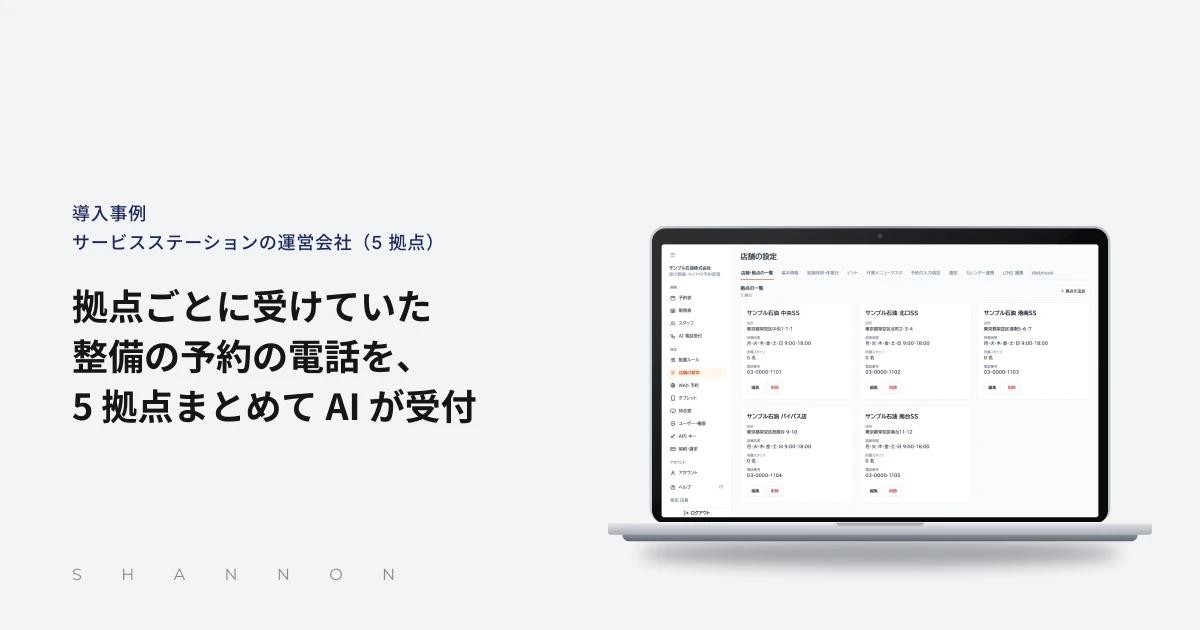
The operator manages five locations, including service stations and a maintenance site, in one account and takes maintenance and tire-change booking calls with AI phone reception.
Challenges before adoption
- Booking calls taken while serving customers at the pumps and car wash
- Calls piling up in tire-change season, interrupting work and service
- Bookings kept per location, with availability elsewhere checked by phone
Results after adoption
- AI answers booking calls and registers them on each location's board
- Staff are notified of bookings and no longer need to stop work
- Bookings for all five locations visible in one account
| Customer | A service-station operator (5 locations) |
|---|---|
| Product | AI Reserve Auto |
| Adopted | October 2026 |
This company operates five locations: four service stations and a maintenance site. Besides fuel and car washes, the service stations take maintenance work such as oil changes, tire changes and inspections, supporting local drivers’ vehicles every day.
Recommending maintenance to fuel customers, taking bookings and turning them into jobs is an important pillar of the business. Bookings, however, depended on each location’s phone, and balancing booking calls with customer service and maintenance work had long been a challenge. In October 2026 the company adopted AI Reserve Auto and began having AI answer booking calls for all five locations. Here is how it came about.
Calls on top of fuel service and maintenance work
At a service station, a small team covers many roles. Staff guide customers at the pumps, handle payments and take car-wash orders while also working in the maintenance bays, and booking calls had to be taken in between.
When the phone rang, staff stopped what they were doing, asked for the customer’s name, contact details, vehicle, desired work and date and time, checked the booking board for availability and took the booking, often still in work clothes and writing on the board by hand.
Answering during maintenance interrupted the job; answering while a fuel customer waited meant neglecting the forecourt. Whichever came first, the other suffered. Missed calls meant missed bookings, and customers had to keep calling back.
Call volume was not even through the year. In the seasonal tire-change periods, tire-change calls concentrated in a short window while the work itself increased. Calls overlapped, staff stopped work one after another to answer, and there was a risk of missing items when taking details in a hurry.
The company saw limits in adding staff for peak periods, since extra staff would be idle the rest of the year. It needed a way to take call handling off staff’s hands altogether.
Booking management confined to each location
The other issue was that bookings were managed per location. Each kept its own booking board and knew only its own schedule. If one location was full, the only way to know whether another had space was to phone it.
Staff could not easily offer another location on the spot, so some customers were asked to forgo booking, and calls between locations added to everyone’s load. Seeing how many bookings each location had meant collecting each board.
The way bookings were taken also differed slightly by location: the items asked, the names of jobs and the expected duration. If the guidance a customer receives depends on which location they call, the company cannot deliver the same quality. As a multi-site operator, it needed to unify and streamline both booking intake and management.
Multiple locations and AI phone reception in one system
The company considered several options: a web booking system for each location, a shared spreadsheet booking board and a phone answering service. Web booking alone would not serve customers who prefer to call, a shared spreadsheet would not reduce calls, and an answering service would still require transcribing bookings onto each location’s board.
It chose AI Reserve Auto, a booking and shift management cloud service for repair shops and tire stores, because it can manage multiple locations in one account and lets AI answer booking calls and register bookings on the board. With call intake and booking management connected, nothing needs to be copied over.
Building its own system was also considered, but preparing and maintaining AI phone answering in-house was not realistic. Using a system designed for maintenance businesses let the company focus its effort on operation after rollout.
What mattered most was that customers could keep booking by phone as before. Many service-station customers prefer the phone. Rather than asking them to change, the company changed how calls are received, keeping things convenient for customers while easing the load on staff.
Registering five locations and a shared service menu
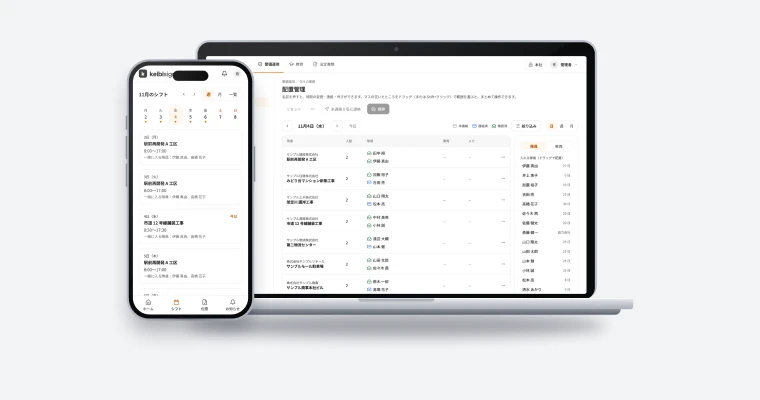
The company first registered its four service stations and the maintenance site in one account. Each location keeps its own booking board, while bookings for the whole company can be seen on the same screen.
Next it set up the service menu, organizing the jobs each location takes, such as oil changes, tire changes and inspections, and registering them with shared content. With a common menu, what the AI asks on the phone is the same and every location’s bookings follow the same flow, which also became an opportunity to standardize booking practices that had differed by location.
The time each job takes was organized as well, so that bookings reflect the correct duration on the board and AI-taken bookings fit the bay schedule without strain.
With the settings in place, the company activated the AI phone reception number and began operation. Staff were shown how AI-taken bookings appear on the board and how notifications arrive, and the steps to follow after a notification were shared.
Care taken not to confuse customers
The company was careful not to unsettle customers. For those used to talking to staff directly, an AI answering the phone is a new experience, so staff let customers know at the counter and when taking bookings that booking calls are now answered by AI.
What the AI asks was aligned with the items staff used to confirm by phone: name, contact details, vehicle, desired work and date and time. Because the same information reaches the booking board as before, preparation after a booking did not have to change.
In the early period, staff checked the contents of AI-taken bookings for anything missing, and where they noticed something, they revised the menu descriptions or settings to make conversations with customers go smoothly.
Some jobs cannot be decided without seeing the vehicle. For such enquiries, the company decided that the person in charge reviews what was received and contacts the customer if needed. Clarifying what the AI handles and what staff take over keeps the quality of customer service.
Taking bookings without stopping work, and seeing every location’s schedule
Booking calls are now answered by AI. The AI asks for the desired work and date and time and registers the booking on the relevant location’s board. The person in charge is notified, so staff no longer need to interrupt work or service to answer the phone.
Staff check notifications to understand each booking and prepare for the job, and can concentrate on serving fuel customers and doing maintenance. Even in periods of concentrated calls such as tire-change season, bookings can be taken without stopping staff.
The company also organized how staff use the board and notifications: checking the day’s schedule on the board at the start of the morning and following new bookings through notifications during the day, with the same flow at every location.
Because all five locations share one account, there is no longer any need to phone another location to check availability. Location managers can see other locations’ schedules alongside their own, for example checking which jobs a service station can take on a day when the maintenance site is busy. With booking practices and board usage aligned, staff helping out at another location can work with the same screen and procedure.
Extending to shift management
Getting through peak periods such as tire-change season with AI phone reception is the company’s main near-term goal. Through that experience it will review the service menu and booking flow again and look for ways to take more bookings without strain.
The company then plans to extend AI Reserve Auto to staff shift management at each location. Handling bookings and shifts in the same system would let it plan locations more deliberately, for example scheduling the staff needed on busy days in advance and checking that the people required for booked jobs are on shift. Planning support between locations should also become easier on the same screen.
By connecting booking intake, job schedules and staff assignment in one system, the company aims to run all five locations to the same standard, keeping the convenience of booking with a single call for customers while letting front-line staff focus on their real work.
Key features
- Multiple locations
- Service menu
- AI phone reception
- Booking board
- Notifications