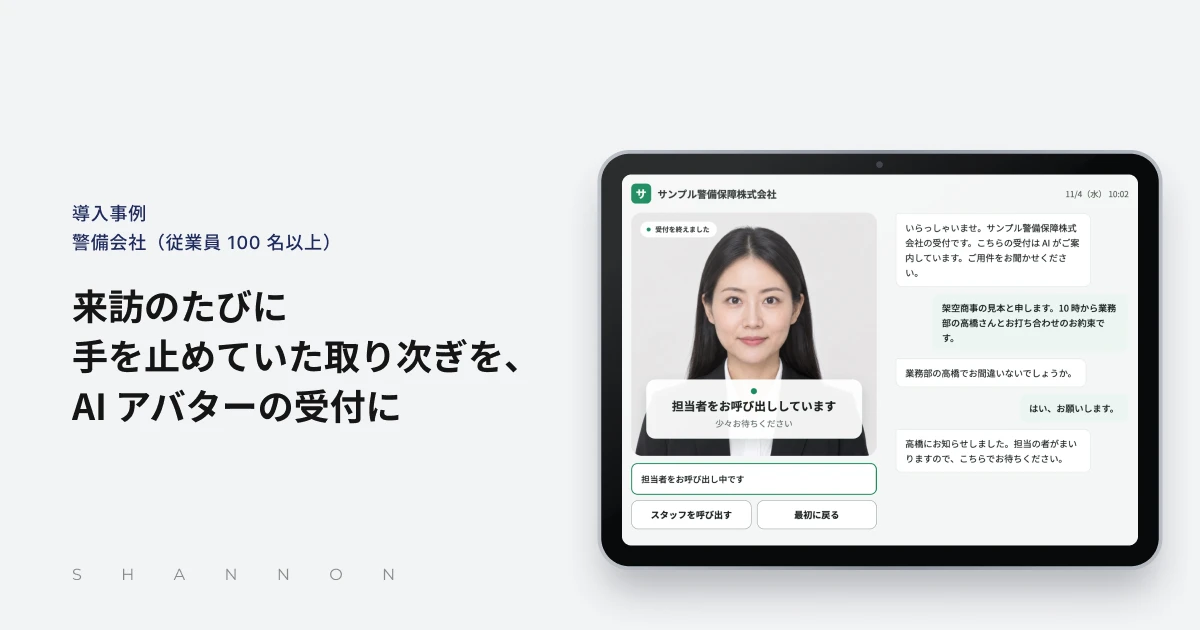
A tablet at head-office reception runs an AI avatar that asks visitors their business and notifies the right person on Google Chat.
Challenges before adoption
- A nearby employee stopped work to handle every visitor
- With no receptionist, visitor handling fell on certain employees
- Not keeping visitors waiting while reducing interruptions to staff
Results after adoption
- The AI avatar asks visitors their business and notifies the right person on Google Chat
- Fewer interruptions to employees for handling visitors
- The person being visited comes straight to reception after the notice
| Customer | A security company (100+ employees) |
|---|---|
| Product | AI Recept |
| Adopted | October 2026 |
This security company has more than 100 employees and provides facility security, traffic control and other services. Its head office receives a steady stream of visitors: client representatives, job applicants, contractors and others. Security work is closely tied to greeting and guiding people, and the company has always expected courtesy in how it receives visitors.
In October 2026 the company ran a proof of concept of unstaffed reception using a conversational AI avatar at its head office, and based on the results adopted AI Recept, a visitor-reception system for offices. This case describes why a security company took up AI reception and how it reached day-to-day operation.
A head office without a dedicated receptionist
The head office has no dedicated receptionist. Office employees handle assignment coordination, client communication and preparation for guard training, and have received visitors in between.
When a visitor arrived, an employee seated near the entrance would get up, ask their business and whom they were visiting, check the person’s desk or schedule, and if necessary look around the office or call them on the extension. Sometimes the employee stayed with the visitor until the person arrived.
Each instance was brief, but on days with several visitors the same employees were interrupted again and again. The work tended to fall on those sitting near the entrance or used to receiving visitors, and their own tasks were sometimes pushed back.
Hiring a dedicated receptionist was an option, but with visitor numbers varying widely from day to day, keeping someone at the desk at all times was not efficient. And when the usual employees were away from their desks, a visitor could wait at the entrance without anyone noticing.
The courtesy the company values as a security provider
For the company, receiving visitors is more than passing on messages. Security work involves speaking to facility users and passers-by and guiding them politely every day. The company regards this courtesy as part of its service quality and emphasizes it in guard training.
The same thinking applies to visitors at the head office. For clients and job applicants, reception shapes their first impression of the company. Not keeping visitors waiting, understanding their business correctly and connecting them reliably to the right person were essential to maintaining trust.
With employees interrupting their work to receive visitors, however, the quality of the welcome depended on how busy and how experienced that employee happened to be. The company needed a way to avoid keeping visitors waiting while reducing interruptions.
It was also clear that any system taking over reception must not change the spirit in which visitors are received. Mechanical guidance that left a cold impression could damage trust in a security company. Whether a system could deliver both efficiency and courtesy became the criterion for choosing one.
A proof of concept: reception completed just by speaking
The company focused on a form of reception in which visitors finish simply by speaking. Other approaches exist, such as selecting the person on a screen or using an extension phone at the entrance, but these can be a burden for visitors unused to screens or unsure of the exact name of the person they are visiting.
The company therefore ran a proof of concept of unstaffed reception with a conversational AI avatar at its head office, testing whether visitors could complete reception just by telling the avatar on a tablet their business and whom they were visiting.
The proof of concept checked whether visitors could talk to the avatar without hesitation, whether the AI found the right person, and whether the notice reliably reached them. It also checked whether the avatar’s manner of speaking and wording suited the courteous welcome the company values.
Concluding that reception completed by speaking suited the head office, the company decided to introduce AI Recept, a visitor-reception system for offices now provided jointly with its developer. It also confirmed that office employees could update the staff directory and visit purposes themselves without special knowledge, an important condition for an office without a receptionist.
Starting with the staff directory and visit purposes
The first step was registering the staff directory. Names and departments were organized and entered so that the AI could find the right person from the name or department a visitor mentions, even when the visitor does not remember the name exactly.
Next, visit purposes were set up. The company sorted the kinds of visits the head office receives, such as client meetings, job interviews and deliveries or contractor visits, so that each could be handled appropriately.
Google Chat, already used daily within the company, was set as the notification channel. Employees receive visitor notices through a tool they already know, and can see them on their own devices even when away from their desks.
Employees were informed of the new reception flow: how notices arrive and how to greet visitors after receiving one. In the first weeks, the flow from notice to greeting was checked together, and any points noticed, such as missed notices or long waits, were shared to refine the procedure.
Operating rules settled in advance
The company also agreed on several operating rules. One was keeping the staff directory current: if it is not updated when people join, leave or change departments, the AI cannot connect visitors to the right person, so a person was made responsible for updating it in step with HR procedures.
Another was how each kind of visitor is greeted. For a client meeting the person being visited comes out; for an interview, the recruiter; for a delivery or contractor visit, the person receiving it. Combining visit purposes with these rules lets employees act without hesitation when a notice arrives.
The company also discussed what happens when the person cannot come right away. If they are in a meeting or out of the office, a colleague in the same department greets the visitor, so that no one is kept waiting long. Defining where people fill in, rather than leaving everything to the system, was seen as key to keeping the welcome courteous.
The tablet’s position was chosen with care as well: somewhere visitors notice as soon as they enter and can speak calmly. The reception area itself is part of how visitors are welcomed.
Visitors greeted directly, and fewer interruptions
Today a tablet stands at head-office reception, and visitors speak to the avatar on it. The AI asks their business, finds the right person and notifies them on Google Chat. The visitor is told that the person has been contacted and waits there to be met.
The person being visited comes to reception in person, so other employees no longer act as go-betweens. For visitors, being greeted directly by the person they came to see makes the process clearer. The avatar welcomes them with wording that reflects the courtesy the company values.
With the AI handling the first contact, employees are interrupted less often for visitors. The load no longer concentrates on those near the entrance or used to receiving guests, and office staff can focus on their own work.
Because the notice arrives on Google Chat, the person being visited can see the visitor’s name and business before heading to reception, and can bring meeting materials or otherwise prepare. Employees who used to relay visitors no longer have to leave their desks each time, and those receiving visitors now take responsibility for greeting their own guests.
Carrying courtesy into AI reception
With reception organized as a system, visitors are received with the same quality whoever is in the office, and the welcome no longer depends on one employee’s circumstances, a real step forward for the company.
The company will keep reviewing reception operation and establishing AI reception at the head office. Based on visitors’ reactions and feedback from employees, it will adjust visit purposes and the staff directory as needed. How visitors actually describe their business only becomes clear in practice, and the company intends to refine the settings accordingly so that the AI connects visitors to the right person more reliably.
The courteous guidance cultivated in security work applies not only when people receive visitors but also when AI does. Through its new reception system, the company intends to give shape to its commitment to welcoming every visitor with care.
Key features
- AI avatar reception
- Staff directory
- Visit purposes
- Google Chat notifications