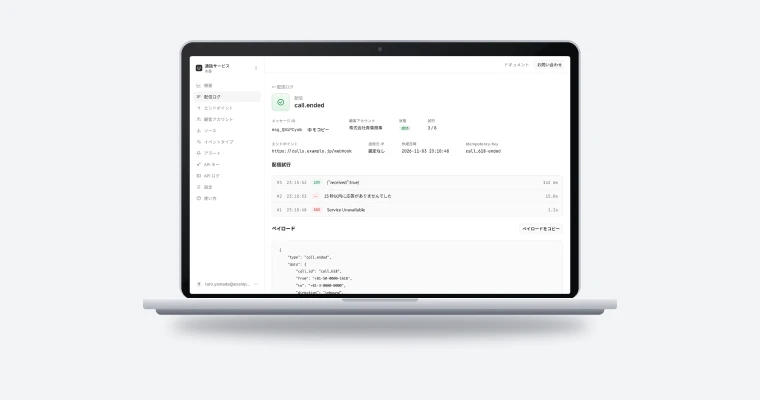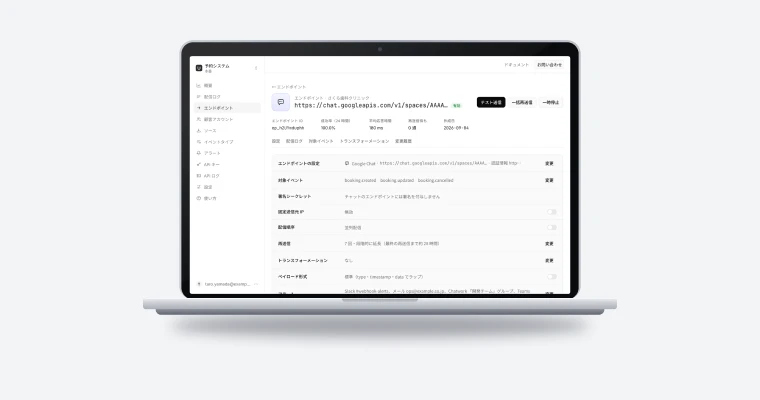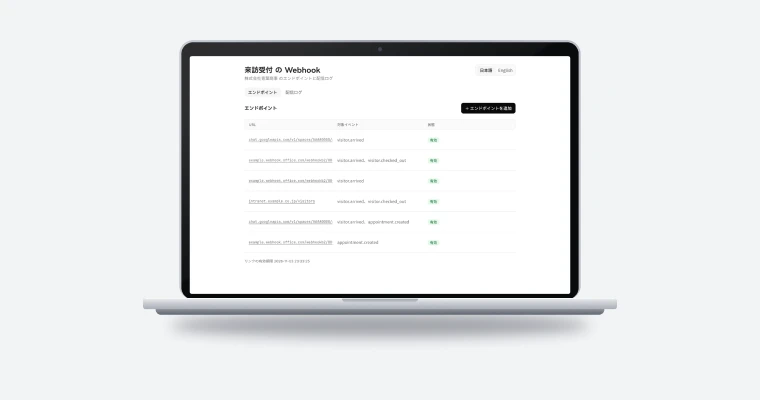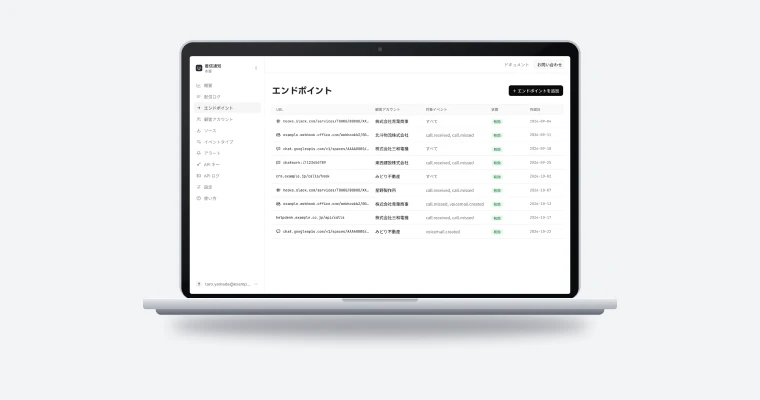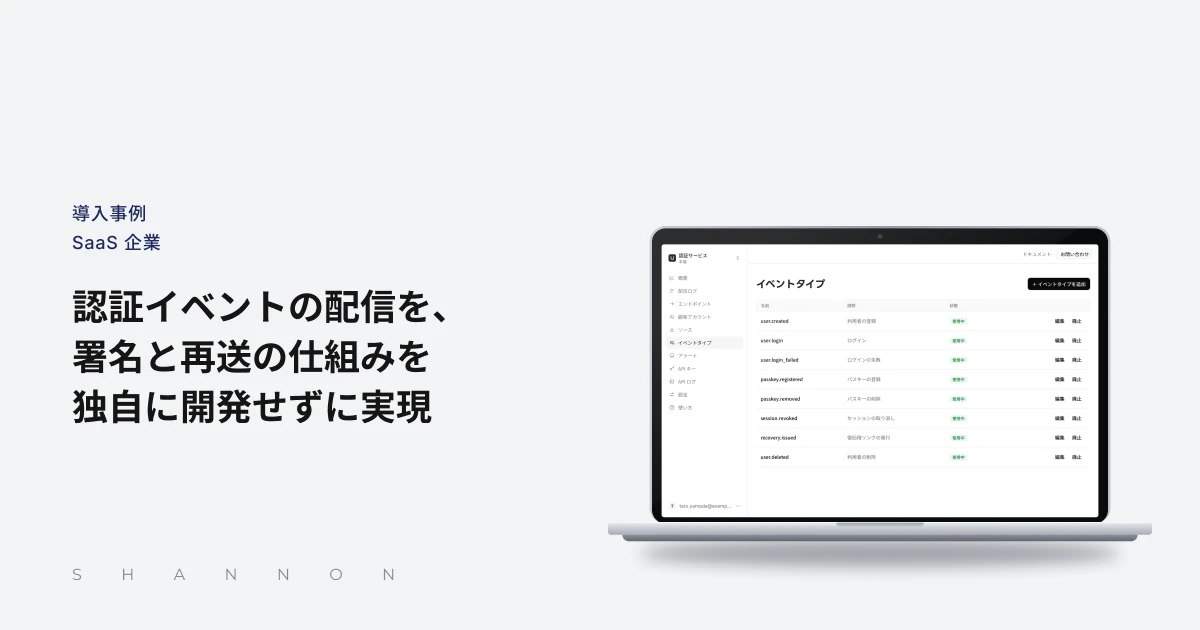
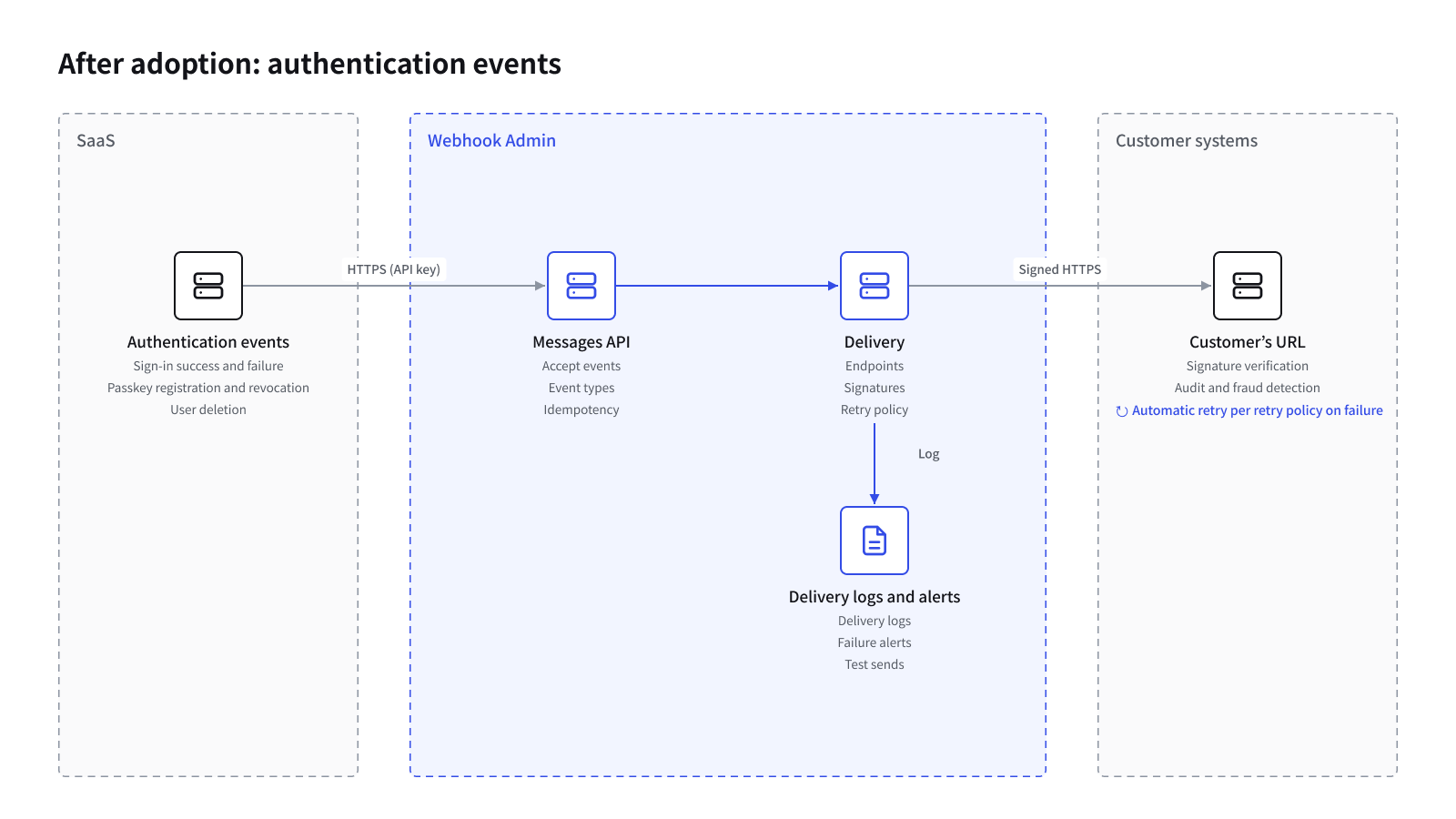
The service delivers sign-in success and failure, passkey registration and revocation, and user deletion events through Webhook Admin, signed, to the URL each customer registers.
Challenges before adoption
- Customers wanted authentication events in their own systems for auditing and fraud detection
- Security-related events require tamper protection and reliable delivery
- Building and running signing, retries and delivery logs in-house was a heavy burden
Results after adoption
- Authentication events arrive signed, and customers verify them before processing
- Failed events are retried, and delivery status can be checked in the logs
- No delivery system to run in-house, so development stays focused on authentication
| Customer | A SaaS company |
|---|---|
| Product | Webhook Admin |
| Adopted | October 2026 |
This company provides a service that adds passkey authentication to existing logins. Customers embed it in the web services and business systems they run, so that users can sign in with a passkey instead of, or alongside, a password. Most customers are businesses offering their own services or companies running internal business systems.
When authentication is entrusted to an outside service, customers want to know what is happening at sign-in in their own systems too. The company built a way to deliver authentication events, such as sign-ins and passkey registrations, to customers’ systems with signatures through Webhook Admin. This is how it made authentication event delivery possible.
Customers wanting authentication events in their own systems
Passkeys are being adopted by many services as a way to prevent unauthorized sign-ins caused by reused or leaked passwords. With the company’s service, customers can add passkeys to an existing login screen without building authentication from scratch.
Authentication, however, is the most important entry point to a customer’s service. Who signed in and when, whether there were failed attempts, and when a new passkey was registered are all essential for auditing and fraud detection. Sign-in records can be checked in the service’s admin console, but customers asked to receive this information in their own systems as well and handle it together with their other records.
One customer, for example, wanted its own monitoring to detect repeated sign-in failures. Another wanted to review related settings in its own service when a passkey was revoked. Others wanted to clean up their own databases when a user was deleted. Each case needed a way to send notice to the customer’s system when an authentication event occurred.
What security-related events require
Authentication events carry a different weight from other notices. Sign-in successes and failures and passkey registrations and revocations all bear directly on a service’s security. If a third party injected a fake event and the customer’s system treated it as genuine, it could lead to wrong decisions.
Receivers therefore need to confirm that an event really came from the service and was not altered in transit. The usual way is to sign each event and verify the signature on receipt. Choosing a signature scheme, managing keys and documenting verification so customers can implement it were indispensable for an authentication service.
Events also have to arrive reliably. If an event is lost because the customer’s system briefly fails to respond, gaps appear in audit records. A way to resend failed events and keep a record of delivery results was needed.
The burden of building signing and retries in-house
The company first considered building this delivery system in-house. As it looked closer, the amount of work required became clear.
Signing involves choosing a scheme, issuing and managing keys, and protecting receivers against old events being replayed. Retries require deciding intervals and limits and how to handle a customer system that stays unresponsive. Delivery records must be kept and be checkable when customers ask.
None of this is the company’s core, passkey authentication. Once built, it would need monitoring, fixes and updates as specifications change. For a company wanting to focus on making authentication safer and more reliable, carrying its own delivery system would be a heavy burden.
Having customers fetch records periodically was also an option, but it delays when customers learn of events and does not suit uses like fraud detection, where speed matters. Sending notice to the customer’s system as events occur was judged the best fit for what customers wanted.
A delivery platform with signing, retries and logs built in
The company chose Webhook Admin. Webhook Admin delivers events with signatures based on Standard Webhooks, a published specification, resends events that fail and keeps a record of delivery results. It also provides event types and per-destination management.
Signatures based on a published specification mattered to the company. Customers can implement verification by following the specification, the company does not have to define and explain its own scheme, and customers find the steps easier to understand.
Valuing the ability to use a delivery system with signatures, retries and logs as it is, the company adopted Webhook Admin. With delivery handed over, it can concentrate on designing which authentication events to send and what they contain.
Designing event types and a destination per app
The first step was deciding which events to deliver. Based on customer requests, the company registered sign-in success, sign-in failure, passkey registration, passkey revocation and user deletion as separate event types in Webhook Admin. Separate types let receivers tell from the type alone what processing is needed.
Event content was organized per type. Authentication events include which user the event concerns and when it occurred. The fields were checked one by one so that receivers get what they need for processing while no authentication secrets are included.
Customers enter the destination URL in the app settings of the service’s admin console. In the service, customers create an app for each of their services. Because each app has its own destination, customers running several services can receive each service’s events in the corresponding system. The registered URL is managed in Webhook Admin as that app’s destination, and when an authentication event occurs, Webhook Admin delivers the event sent from the service.
Guiding verification and a staged rollout
To receive authentication events, customers need to prepare a receiver and signature verification. The company’s documentation for customers sets out what each event type contains and the steps for verifying the signature before processing. Not processing any event that fails verification is presented as the basic rule for receivers.
Once a destination is registered, customers can check the delivery logs to see whether events are arriving. If the customer’s system briefly fails to respond, Webhook Admin resends the event, preventing it from being lost. If retries keep failing, the result is recorded, and support staff can ask the customer to check its settings based on the record.
Rather than opening delivery to all customers at once, the company rolled it out in stages. It first registered a destination for an app it runs internally and performed sign-ins and passkey registrations to confirm that events arrived with the expected content. It also implemented signature verification internally by following the customer documentation, checking it for gaps or unclear points.
Test sends were used along the way. A test send delivers an event to the destination without a real authentication event, so receivers can be checked. Customers are also advised to confirm receipt and signature verification with a test send after registering a URL, before wiring events into their actual processing.
After internal checks, delivery was offered first to the customers who had asked for it. Until customers have a receiver ready, they can keep checking sign-in records in the admin console as before, so there is no need to rush. Customers register a destination and start receiving events once they are ready.
Development focused on authentication
With Webhook Admin, authentication events now reach customers’ systems with signatures. Customers verify the signature before processing, so they can feed events into audit records and fraud detection with confidence. Failed deliveries are resent, making gaps in records less likely.
Customers can now trigger processing in their own systems from authentication events: noticing repeated sign-in failures in their own monitoring, reviewing related settings when a passkey is revoked, or cleaning up their databases when a user is deleted, all without going to the admin console to check.
The company no longer needs a delivery system of its own. With key management, retry rules and delivery logs handled by Webhook Admin, developers can spend their time on making passkey authentication easier to use and more secure.
Delivery logs also help support. When a customer reports missing events, the logs show when, to which destination and with what result each event was delivered, so the company and the customer can work out together whether the problem lies in the receiver or the destination settings.
The company plans to keep expanding the event types it delivers in line with customer needs. By delivering what happens at sign-in reliably, backed by signatures and retries, it will help customers raise the security of their own services.
Key features
- Event types
- A destination per app
- Signatures and retries
- Delivery logs